It’s
the end of the semester, and that means grading. For many of us in higher ed, this
is only a continuation of the grading madness that inevitably seems to engulf
the second half of the semester.
My
back is aching, my wrists are tired, and my thighs are scorched from too much
laptop-on-lap time, yet I have to admit I’m enjoying reading my students’
paper drafts in my American literature class.
 |
| I will be the first to voice my concern about rising class sizes and the detriment they pose to student learning, but grading can also be a conversation. |
The
course is a survey, which I’ve written about before, and it’s my first time teaching
an American literature course. I’ve been in my “BritLit” pigeon-hole for so
long, and then suddenly I found myself discussing pilgrims and Puritans,
conquistadors and Christians, revolution and social rebellion.
 I
found myself enjoying the course quite a bit. I still find American literature
overwhelmingly earnest, moralistic, and overly didactic, but these qualities
also provided excellent fodder for class discussions. The course covered the
earliest texts of the Americas up to the Civil War/1865 which meant that, like
many survey courses, it contained a little bit of everything.
I
found myself enjoying the course quite a bit. I still find American literature
overwhelmingly earnest, moralistic, and overly didactic, but these qualities
also provided excellent fodder for class discussions. The course covered the
earliest texts of the Americas up to the Civil War/1865 which meant that, like
many survey courses, it contained a little bit of everything.
As
we wended our way to the close of the semester, I wondered how my students
would approach the final paper, which charged them with choosing two texts by
two different authors and discussing them together while also using outside
sources. My students had struggled with the first paper of the semester, the
first of two shorter response papers. There was significant improvement on the
2nd response paper, but the final paper requires the students to
analyze texts in conversation with one another and to make more complex
arguments about them.
I
was both pleased and surprised, however, when we discussed the thematic and
stylistic connections between authors in class. Students put together texts in
innovative and compelling ways—and these connections showed up in their paper
drafts as well.
One
student put Emily Dickinson’s poetry in conversation with Benjamin Franklin’s
essay “To Those Who Would Remove to America” in order to make an argument about
how these two very different authors approach the pursuit of happiness. Another
student discussed Walt Whitman’s “Song of Myself” and Frances Ellen Watkins
Harper’s short story “The Two Offers” in order to make an argument about how
these authors understand the self. A third student discussed the individual
versus society using Whitman’s “Song of Myself” and Herman Melville’s
“Bartleby, the Scrivener.”
In
many ways, these would not be combinations that I would have put together at
first glance. I was less surprised, for example, when students wrote about
slavery in Lydia Maria Child’s “The Quadroons” and Harriet Jacob’s Incidents in the Life of a Slave Girl,
or death and horror in Poe’s “The Masque of the Red Death” and Hawthorne’s “The
Minister’s Black Veil.” Just when I thought I’d read all the unusual papers, I
picked up another unusual combination: Washington Irving’s “Rip Van Winkle” and
Poe’s “The Masque of the Red Death” as works that both explore characters who
wish to escape reality.
It’s
possible these combinations seem so unusual to me because I don’t normally
study American literature, but regardless I was excited to note the different
connections students made between texts. Maybe the execution wasn’t stellar,
maybe they still need to flesh out the ideas or add in more quotations—these
papers are still in the draft stage. Nevertheless, I already feel like I have
learned a lot from reading these papers and from seeing my students’
improvement. While commenting on drafts before students turn in the final draft
can be time-consuming, it does mean that paper-writing becomes a conversation
between students and instructors.
When
I think back, I realize that I never got as much feedback on papers in college
as I give now to my students. Of course, I wish my classes were smaller so the
burden of putting comments on papers wasn’t so heavy, but I can’t deny that
this process leads to better communication of requirements, better student
understanding of the writing process, and, ultimately, better quality papers.
Along
the way, I also get to witness the transformation of ideas through writing and
re-writing. I might even, sometimes, read something in a student paper that
sparks my imagination, as when one of my students wrote that Bartleby
perpetrates a type of “metaphysical crime” when he refuses to leave the office
and just “hangs around.” The student further suggests that it is because
Bartleby’s intentions are opaque that his behavior incites the social unrest.
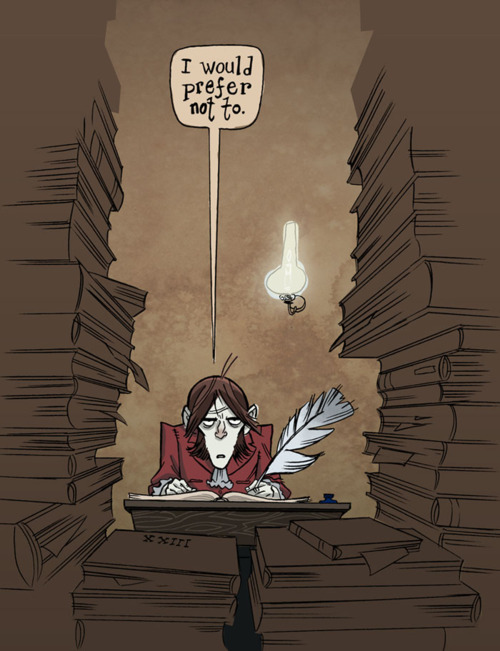 |
| It's hard to miss the irony of Melville's classic short story when I sit down to grade stacks of student papers. |
This
idea reminded me of our class discussions about “Bartleby” and Hawthorne’s “The
Minister’s Black Veil”, and how the behavior of Bartleby and the minister, with
his refusal to explain the veil, provoke social unrest—merely by seeming to be
so different than the rest of the people who surround them. Both Bartleby and
the Hawthorne’s minister challenge social expectations by being unlike
others—and by having veiled intentions. Others project their own insecurities,
shames, and fears onto them, hating these “different” characters because they
remind them of their own inadequacies, their own “secret sins,” to use
Hawthorne’s term.
I
couldn’t help but connect this discussion in class to what has been happening
in Ferguson, MO. Ferguson has been in my classroom conversations all semester,
as I discussed the representation of African Americans on screen in my Writing
1 class; as students researched police brutality in my Writing 2 class; and as
we discussed the history of slavery, abolitionism, and the fraught nature of
personal narrative and the American Dream in my American literature course.
As
with many controversial news stories, the events in Ferguson are subject to
interpretation; each day we see the war of different perspectives on what
happened there. Ferguson is our black veil, it is our Bartleby who won’t leave
the office….we each project onto it our own secret sins, our own explanation of
why it happened and what it means. But like the minister’s veil, which covers
his face even in the grave, sending posthumous shudders through the remaining
citizens, there will never be a simple explanation to the events in Ferguson.
 |
| How do we interpret the many images, headlines, news clips and sound-bites coming out of Ferguson, related protests around the US, or any other news story, for that matter? |
And
so, it’s the end of the semester, and though I’m tired in body, I feel energized
in mind. It’s moments like these that I see clearly why we who research should
also teach; the intellectual interactions we have with our students allow us to
see things anew, to consider new angles, to question the usual juxtapositions
that we rely on for interpreting the world around us—and our research.


