Showing posts with label Anne Lister. Show all posts

Wednesday, June 19, 2019

Gentleman Jack: Revisiting Anne Lister


Lately, there’s been a lot of fanfare around Gentleman Jack, the HBO production that brings to life part of Anne Lister’s copious nineteenth-century diaries. I’m a little behind on the episodes, but I’ve seen the first two, and am looking forward to the rest. The show is smart, funny, with high production quality, and a certain tongue-in-cheek quality that gives it a fun campiness that is perfectly appropriate to the life story of one of British history’s queerest ladies.

Suranne Jones as Anne Lister (left) and Sophie Rundle as Ann Walker
              
  Yes, Anne Lister was a lesbian. And she wore an outfit that was rather masculine for the time period—though she did often wear skirts as well, in keeping with the time period and her class status. And I write about cross-dressing women in literature of the eighteenth century. So, needless to say, people keep telling me about Anne Lister and Gentleman Jack—and as I mentioned on Twitter: I am aware.
                I know that sounds snarky to say, but part of me bristles a bit at the idea that people who know my work would think that I had never heard of Lister. On the other hand, I understand that people who know my work are excited to finally have access to a pop culture artifact that relates to my research and, in general, their enthusiasm is awesome.
                Because the story of Anne Lister really is amazing and intriguing—and it changed much of the thinking about the history of sexuality. Sexuality has a history, and there are hundreds of scholars from many different disciplines, geographical areas, and time periods who are studying what sex meant in the past. My work on lesbian desire and female cross-dressing fits squarely into this area of study, as I’m interested in how women who dressed as men became an object of fascination for the reading public of the eighteenth century and, moreover, how such “butch” women appealed to “femme”/“straight” women in the past. Some women who wore men’s clothing did indeed actually live as men, and in studying them, we also trace the history of trans people; indeed, Lister’s gender nonconformity is an important aspect of who she (or he?) was.
                But going back to Anne Lister…Lister is an important figure because she changed the discussion around sexuality. Cultural historian Michel Foucault theorized that sexual orientation became a category of identification only with the rise of Sigmund Freud’s theories of sexuality and gender roles, as well as the writings of eminent sexologists of the late nineteenth century. Prior to the late nineteenth century (so the thinking goes), people did not think of themselves as straight, gay, bisexual, etc. Those terms did not exist or were not used in the same way as today, and, as such, many scholars in the past (and today) believe that those terms cannot be used effectively or accurately to discuss people in the past.
                The decoding of Lister’s secret diaries in the 1980s by Helena Whitbread changed all that. The juiciest, gossipy-est, and sexiest parts of Lister’s diary were written in a code invented by herself, and she details all her sexual exploits therein. Lister writes in her diary about being only attracted to women. Literary scholar Terry Castle discusses these segments of the diary as an important instance of a woman showing a sexual orientation that is self-aware and same-sex oriented. Castle’s arguments, along with those many others, challenged the Foucauldian ideas about when people began to have sexual identities in the modern sense. While my current research project on cross-dressing women doesn’t analyze Lister’s diaries, the scholarship that reacted to those diaries has informed my own scholarship in crucial ways.
                Lister’s story is definitely a complex one, and I’m not going to get into it here. Now that there is a splashy show about her, the articles about Lister have proliferated. Everyone from Marie Claire to The Atlantic wants to tell you about Lister, how the show portrays her, and in what ways the show is awesome and ground-breaking or how it“misses the mark” etc. From being a figure relegated to the shadows of history, a footnote, a topic of scholarly discussion, Lister is out in the open now (pun intended), and everyone has an opinion about her. Some discussions opening up are important—such as whether to Lister was, in fact, a lesbian, or whether she was a trans (straight) man. There is ample evidence in the diaries that Lister did not enjoy anything having to do with being feminine or womanly, she was a tomboy growing up, and as an adult she preferred men’s clothing. The line between butch lesbian and trans man is and probably shall remain blurred since we obviously can’t go back in time and ask Lister herself, but these discussions are important ones that should serve as reminders that LGBTQ identities have always existed—and will always exist. Other discussions about the show and its depiction are perhaps less interesting (The Atlantic wants to know why Lister is presented in such a positive light, for example, as if we need more sad queers on TV).
                In any case, if you do watch the show and enjoy it, I recommend you read a little more about Lister. Maybe check out Helena Whitbread’s amazing blog about decoding the diaries; or Jeanette Wintersen’s discussion of Lister; or buy the book for an amazing beach read this summer. Don’t let the show be your only source about this fascinating person. (Also: this isn’t the first time Lister’s story has been dramatized, though the Maxine Peak film is about a sadder time in Lister’s life--which I discuss in a previous blog post.)
                And, of course, if you want to know about the longer history of women who dressed in men’s clothing in Britain and British literature, make sure to keep an eye out for my book, Sapphic Crossings, when it comes out at the University of Virginia Press in the near-ish future.

Friday, November 20, 2015

The Secret Diaries of a Regency Lesbian

Anne Lister,
Regency Lesbian
I finally managed to watch The Secret Diaries of Miss Anne Lister, a BBC production from 2010 that tells the story of Anne Lister, an upper-class Englishwoman who defied the conventions of her time to live and love as she wanted to.

Lister, for those of you unfamiliar with her story, lived in Halifax, in Northern England, from 1791-1840. And although her life overlaps quite a bit with that of Jane Austen, her life story and her diary reveal quite a different world than the one Austen recreates in her novels. Lister kept a secret diary, much of which was written in code, and the coded bits are, naturally, the juicy bits. In her copious diary, Lister details her love affairs with various women, as well as her interest in women and her disinterest in men.

Her diaries number 4 million words and naturally touch on many other subjects, but for historians of sexuality, her diary is most important for the way that Lister writes about her same-sex desires and her sexual identity. The “no homosexuals before 1900 rule” that many post-Foucaultian scholars considered to be (used to consider?) a hard and fast assumption seems ridiculous when we consider Lister. She clearly thought of herself as “a woman whose primary romantic and sexual attraction is to other women.”

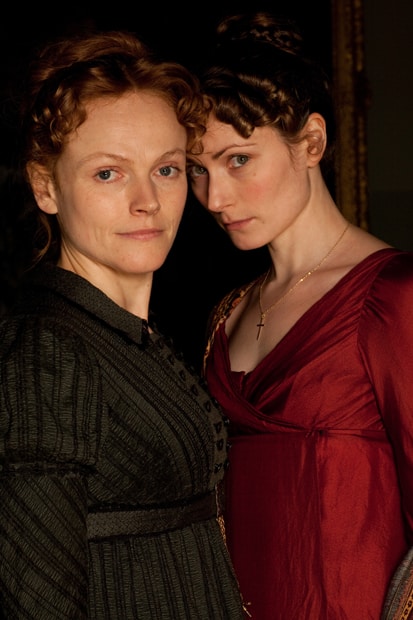
Maxine Peake, left, as Lister, &
Anna Madeley as Mariana Belcombe.
The BBC production, however, was a disappointment. While Maxine Peake, who played Lister, seemed up to the part, she was miscast. She looks absolutely nothing like the portraits of Lister, with her bouncing red curls instead of Lister’s dark brown locks, and the script and story focused on portraying Lister as romantic, desperate, and hysterical. The time line of her life was truncated and mangled in the film, and there was no discernible story arc.

The basic narrative focuses on Lister’s problematic affair with real-life lover Marianna Belcombe (later Lawton) and Lister’s later successful relationship with wealthy heiress Ann Walker. The film also represents some of the other aspects of Lister’s life: her scholarly interests, the changes she made to her home, Shibden Hall, and her interests in engineering and coal-mining. The film also represents some of the negative reactions Lister faced to her increasingly masculine appearance and clothing and the suspicion surrounding her and her female “friends.” Some people in the area who knew of her odd ways called her “Gentleman Jack”—and not in a nice way.

Lister’s life could indeed make a wonderful, exciting, and thought-provoking film, but this one just wasn’t it. Far more interesting was the mini-documentary included in the special features on our disc, called “The Real Anne Lister” with Sue Perkins. The documentary includes interviews with various scholars who study Lister and Regency England, including Helena Whitbread who is the main editor of Lister’s diaries.

“The Real Anne Lister” takes us into Shibden Hall as it looks today and to the boarding school where Anne was sent as a teen—and where she had her first love affair with another girl. In between interviews with scholars and historians, Sue Perkins walks us through Lister’s life and loves, giving us a far more complete picture of Lister as a woman interested in intellectual pursuits, one who actively pursued other women at a time when such relationships were stigmatized, and one who had many other interests as well, including mountaineering, something the fictionalized film does not include.
 
Shibden Hall in Halifax, England.
Perkins presents Lister as a problematic figure, one who, as contemporary lesbians, we can admire for her boldness and her decision not to live in the closet, but who is also deeply troubling and perhaps even unlikable. Perkins notes in the documentary that Lister seems heartless at times, forgetting her lover from her school years, Eliza Raine (who died young after being sent to an insane asylum), and seducing other women thoughtlessly, selfishly. Perkins also faults Lister for being class conscious in her pursuit of other women, focusing mostly on women of the upper middle class and upper class—women like Lister herself.

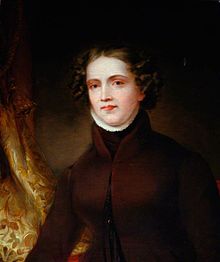
A later portrait of Lister reveals the "mannish"
quality that eventually caused her lover, Mariana,
to leave her.
But we don’t have to like Lister in order to find her fascinating or a worthwhile person to study, especially when it comes to the history of sexuality. After all, no one is sitting around asking if they like Sappho or Don Juan as a person. Perhaps we should be asking, instead, what role does “likeability” and “relatability” have to play when we study real life persons in the past? Undoubtedly most writers of biographies come up against a fact or incident in the life of their subject that turn them off, or maybe even creates a permanent sense of dislike for this person that they are writing about.

Perhaps that was the reason I didn’t like The Secret Diaries of Miss Anne Lister. Aside from the pacing being a bit slow, I felt like I just didn’t like Anne Lister. And I wanted to. But her fictionalized character didn’t seem bold and brash, or even cold and cunning; she seemed desperate and a teensy bit annoying. I do hope that her story gets take up again, though, and remade into a better film (or mini-series, or even a musical!) because it’s a story worth knowing.


For every brash, bold, rich Anne Lister, there are dozens of other, quieter, lesser-known, or simply poorer women in history who loved other women and who defied conventions—perhaps in a less splashy way. Their lives are just as worth knowing and understanding as those of queens and duchesses, and their presence in the past suggests a more sexually diverse Regency world than most Austen adaptations present us with. 
On a positive note, the BBC production doesn't shy away from
representations of female same-sex desire and sex acts.