Showing posts with label cross-dressing women. Show all posts

Wednesday, June 19, 2019

Gentleman Jack: Revisiting Anne Lister


Lately, there’s been a lot of fanfare around Gentleman Jack, the HBO production that brings to life part of Anne Lister’s copious nineteenth-century diaries. I’m a little behind on the episodes, but I’ve seen the first two, and am looking forward to the rest. The show is smart, funny, with high production quality, and a certain tongue-in-cheek quality that gives it a fun campiness that is perfectly appropriate to the life story of one of British history’s queerest ladies.

Suranne Jones as Anne Lister (left) and Sophie Rundle as Ann Walker
              
  Yes, Anne Lister was a lesbian. And she wore an outfit that was rather masculine for the time period—though she did often wear skirts as well, in keeping with the time period and her class status. And I write about cross-dressing women in literature of the eighteenth century. So, needless to say, people keep telling me about Anne Lister and Gentleman Jack—and as I mentioned on Twitter: I am aware.
                I know that sounds snarky to say, but part of me bristles a bit at the idea that people who know my work would think that I had never heard of Lister. On the other hand, I understand that people who know my work are excited to finally have access to a pop culture artifact that relates to my research and, in general, their enthusiasm is awesome.
                Because the story of Anne Lister really is amazing and intriguing—and it changed much of the thinking about the history of sexuality. Sexuality has a history, and there are hundreds of scholars from many different disciplines, geographical areas, and time periods who are studying what sex meant in the past. My work on lesbian desire and female cross-dressing fits squarely into this area of study, as I’m interested in how women who dressed as men became an object of fascination for the reading public of the eighteenth century and, moreover, how such “butch” women appealed to “femme”/“straight” women in the past. Some women who wore men’s clothing did indeed actually live as men, and in studying them, we also trace the history of trans people; indeed, Lister’s gender nonconformity is an important aspect of who she (or he?) was.
                But going back to Anne Lister…Lister is an important figure because she changed the discussion around sexuality. Cultural historian Michel Foucault theorized that sexual orientation became a category of identification only with the rise of Sigmund Freud’s theories of sexuality and gender roles, as well as the writings of eminent sexologists of the late nineteenth century. Prior to the late nineteenth century (so the thinking goes), people did not think of themselves as straight, gay, bisexual, etc. Those terms did not exist or were not used in the same way as today, and, as such, many scholars in the past (and today) believe that those terms cannot be used effectively or accurately to discuss people in the past.
                The decoding of Lister’s secret diaries in the 1980s by Helena Whitbread changed all that. The juiciest, gossipy-est, and sexiest parts of Lister’s diary were written in a code invented by herself, and she details all her sexual exploits therein. Lister writes in her diary about being only attracted to women. Literary scholar Terry Castle discusses these segments of the diary as an important instance of a woman showing a sexual orientation that is self-aware and same-sex oriented. Castle’s arguments, along with those many others, challenged the Foucauldian ideas about when people began to have sexual identities in the modern sense. While my current research project on cross-dressing women doesn’t analyze Lister’s diaries, the scholarship that reacted to those diaries has informed my own scholarship in crucial ways.
                Lister’s story is definitely a complex one, and I’m not going to get into it here. Now that there is a splashy show about her, the articles about Lister have proliferated. Everyone from Marie Claire to The Atlantic wants to tell you about Lister, how the show portrays her, and in what ways the show is awesome and ground-breaking or how it“misses the mark” etc. From being a figure relegated to the shadows of history, a footnote, a topic of scholarly discussion, Lister is out in the open now (pun intended), and everyone has an opinion about her. Some discussions opening up are important—such as whether to Lister was, in fact, a lesbian, or whether she was a trans (straight) man. There is ample evidence in the diaries that Lister did not enjoy anything having to do with being feminine or womanly, she was a tomboy growing up, and as an adult she preferred men’s clothing. The line between butch lesbian and trans man is and probably shall remain blurred since we obviously can’t go back in time and ask Lister herself, but these discussions are important ones that should serve as reminders that LGBTQ identities have always existed—and will always exist. Other discussions about the show and its depiction are perhaps less interesting (The Atlantic wants to know why Lister is presented in such a positive light, for example, as if we need more sad queers on TV).
                In any case, if you do watch the show and enjoy it, I recommend you read a little more about Lister. Maybe check out Helena Whitbread’s amazing blog about decoding the diaries; or Jeanette Wintersen’s discussion of Lister; or buy the book for an amazing beach read this summer. Don’t let the show be your only source about this fascinating person. (Also: this isn’t the first time Lister’s story has been dramatized, though the Maxine Peak film is about a sadder time in Lister’s life--which I discuss in a previous blog post.)
                And, of course, if you want to know about the longer history of women who dressed in men’s clothing in Britain and British literature, make sure to keep an eye out for my book, Sapphic Crossings, when it comes out at the University of Virginia Press in the near-ish future.

Wednesday, October 14, 2015

Two Feminisms: Mary Astell and Hortense Mancini


Hortense Mancini,
Duchess of Mazarin
It happens more often than I’d like to admit: despite writing an entire dissertation on cross-dressing women in British literature and culture of the long eighteenth century, I find I’ve overlooked a prominent female cross-dresser. Today’s case is that of Hortense Mancini, Duchess of Mazarin, and one of Charles II’s many mistresses.

Mancini’s flamboyant, exciting, and at times perilous life has been documented and described not only in books, like her biography The Mazarin Legacy, by Toivo David Rosvall and in Elizabeth C. Goldsmith’s The King’s Mistresses, but also in various wonderful blog posts on the blogs Two Nerdy History GirlsThe Monstrous Regiment of WomenWonders and Marvels, as well as MadameGuillotine.

 I, however, learned about Mancini just today as I was considering including Mary Astell, the “first British feminist”, in the Month of Dangerous Women on my own blog. Astell’s Some Reflections UponMarriage was written in direct response to the case of the Duchess of Mazarin and her husband’s suing for divorce after many years of separation.

Protofeminist Mary Astell
Astell’s opinion of the case is tinged with condemnation of Mancini’s behavior; Astell was, after all, a rather conservative feminist. She writes that “Had Madam Mazarine's Education made a right improvement of her Wit and Sense, we should not have found her seeking Relief by such imprudent, not to say Scandalous Methods, as the running away in Disguise with a spruce Cavalier, and rambling to so many Courts and Places, nor diverting her self with such Childish, Ridiculous, or Ill-natur'd Amusements, as the greatest part of the Adventures in her Memoirs are made up of.”

Oh yes, did I mention? Mancini published her memoirs…I can’t wait to get my hands on those!

In any case, however, to return to Astell, I was intrigued, naturally, by her claims. Some quick research into the life of Mancini revealed not only that she frequently cross-dressed as a man, but also that she openly had lovers of both sexes and, at one point, engaged in a duel with swords with Anne Lennard, Countess of Sussex, the illegitimate fifteen-year-old daughter of Charles II by another of his mistresses, Barbara Villiers. Lennard was most likely also one of Mancini’s female lovers at court. 

Whatever Astell thought of Mancini and her “ill-natured amusements,” Hortense Mancini reminds us that there were women in the past who lived life fully, dangerously, and dashingly, with little regard to what the rest of the world thought of them. This is not to say that Astell was wrong about everything either. Astell’s thoughts on marriage and divorce reveal a woman far  beyond her time, one who believed that

“To be yoak'd for Life to a disagreeable Person and Temper; to have Folly and Ignorance tyrannize over Wit and Sense; to be contradicted in every thing one does or says, and bore down not by Reason but Authority; to be denied ones most innocent desires for no other cause, but the Will and Pleasure of an absolute Lord and Master, whose follies a Woman with all her Prudence cannot hide, and whose Commands she cannot but despise at the same time she obeys them, is a misery none can have a just Idea of, but those who have felt it.”

Clearly Astell believed that men and women should have simpler, more direct recourse to divorce in cases where the relationship is of no benefit to one or both of sides of it. In the Reflections, as well as in her Serious Proposal to the Ladies, Astell eviscerates many of the common marital practices of her time period while advocating for greater educational opportunities for women.

For these reasons, this week’s contribution to the Dangerous Women series is a double-whammy. Hortense Mancini and Mary Astell were both “dangerous women” by my definition—they dared to step beyond the “traditional” role of women, to assert themselves as independent, free-thinking individuals, and to challenge society’s expectations for their sex.

The lives of these women and their writings also made me think about the different feminisms and forms of female empowerment that women espouse today. Feminism is still stigmatized in our society—as are women of strength, independence, power, and intelligence.
 
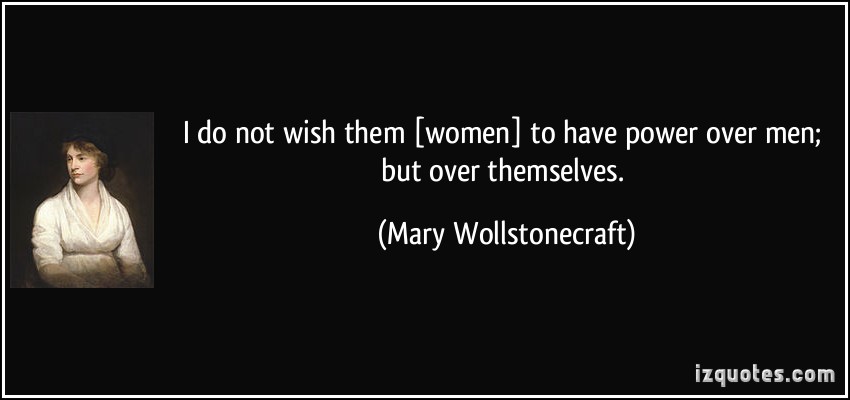
Another early feminist, Mary Wollstonecraft, believed like Astell that women needed
education in order to empower themselves and their countries.
This quotation of hers, however, is ambiguous enough to encompass a variety
of different ways in which women today might gain "power over themselves."
Mancini epitomizes women who live as they wish, who use their relationships with men to facilitate and support their lives and interests, who live freely but perhaps without knowledge of or interest in academic debates on feminism. Conversely, Astell epitomizes women who believe that if women want equality and respect, they must be educated, intelligent, and aware of how their behavior may at times contribute to their oppression.

These are only two attitudes, of course, towards female empowerment and feminism, and many men and women’s ideas may fall somewhere in between. Further, many of us draw on both of these women’s attitudes during our everyday lives. I don’t think these ideas and attitudes have to be opposed to each other, either. Contemporary feminism emphasizes choice, and I choose to admire both Mancini and Astell for their determination, intelligence, independence and panache, however they ultimately chose to express themselves.