Showing posts with label female cross-dressers. Show all posts

Wednesday, October 14, 2015

Two Feminisms: Mary Astell and Hortense Mancini


Hortense Mancini,
Duchess of Mazarin
It happens more often than I’d like to admit: despite writing an entire dissertation on cross-dressing women in British literature and culture of the long eighteenth century, I find I’ve overlooked a prominent female cross-dresser. Today’s case is that of Hortense Mancini, Duchess of Mazarin, and one of Charles II’s many mistresses.

Mancini’s flamboyant, exciting, and at times perilous life has been documented and described not only in books, like her biography The Mazarin Legacy, by Toivo David Rosvall and in Elizabeth C. Goldsmith’s The King’s Mistresses, but also in various wonderful blog posts on the blogs Two Nerdy History GirlsThe Monstrous Regiment of WomenWonders and Marvels, as well as MadameGuillotine.

 I, however, learned about Mancini just today as I was considering including Mary Astell, the “first British feminist”, in the Month of Dangerous Women on my own blog. Astell’s Some Reflections UponMarriage was written in direct response to the case of the Duchess of Mazarin and her husband’s suing for divorce after many years of separation.

Protofeminist Mary Astell
Astell’s opinion of the case is tinged with condemnation of Mancini’s behavior; Astell was, after all, a rather conservative feminist. She writes that “Had Madam Mazarine's Education made a right improvement of her Wit and Sense, we should not have found her seeking Relief by such imprudent, not to say Scandalous Methods, as the running away in Disguise with a spruce Cavalier, and rambling to so many Courts and Places, nor diverting her self with such Childish, Ridiculous, or Ill-natur'd Amusements, as the greatest part of the Adventures in her Memoirs are made up of.”

Oh yes, did I mention? Mancini published her memoirs…I can’t wait to get my hands on those!

In any case, however, to return to Astell, I was intrigued, naturally, by her claims. Some quick research into the life of Mancini revealed not only that she frequently cross-dressed as a man, but also that she openly had lovers of both sexes and, at one point, engaged in a duel with swords with Anne Lennard, Countess of Sussex, the illegitimate fifteen-year-old daughter of Charles II by another of his mistresses, Barbara Villiers. Lennard was most likely also one of Mancini’s female lovers at court. 

Whatever Astell thought of Mancini and her “ill-natured amusements,” Hortense Mancini reminds us that there were women in the past who lived life fully, dangerously, and dashingly, with little regard to what the rest of the world thought of them. This is not to say that Astell was wrong about everything either. Astell’s thoughts on marriage and divorce reveal a woman far  beyond her time, one who believed that

“To be yoak'd for Life to a disagreeable Person and Temper; to have Folly and Ignorance tyrannize over Wit and Sense; to be contradicted in every thing one does or says, and bore down not by Reason but Authority; to be denied ones most innocent desires for no other cause, but the Will and Pleasure of an absolute Lord and Master, whose follies a Woman with all her Prudence cannot hide, and whose Commands she cannot but despise at the same time she obeys them, is a misery none can have a just Idea of, but those who have felt it.”

Clearly Astell believed that men and women should have simpler, more direct recourse to divorce in cases where the relationship is of no benefit to one or both of sides of it. In the Reflections, as well as in her Serious Proposal to the Ladies, Astell eviscerates many of the common marital practices of her time period while advocating for greater educational opportunities for women.

For these reasons, this week’s contribution to the Dangerous Women series is a double-whammy. Hortense Mancini and Mary Astell were both “dangerous women” by my definition—they dared to step beyond the “traditional” role of women, to assert themselves as independent, free-thinking individuals, and to challenge society’s expectations for their sex.

The lives of these women and their writings also made me think about the different feminisms and forms of female empowerment that women espouse today. Feminism is still stigmatized in our society—as are women of strength, independence, power, and intelligence.
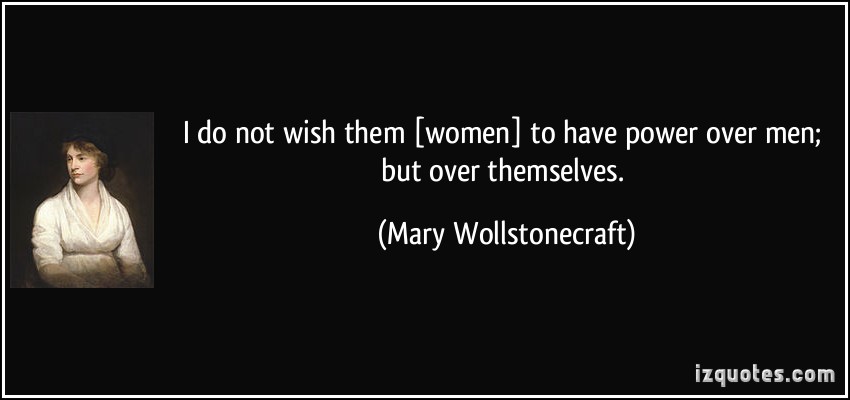
 
Another early feminist, Mary Wollstonecraft, believed like Astell that women needed
education in order to empower themselves and their countries.
This quotation of hers, however, is ambiguous enough to encompass a variety
of different ways in which women today might gain "power over themselves."
Mancini epitomizes women who live as they wish, who use their relationships with men to facilitate and support their lives and interests, who live freely but perhaps without knowledge of or interest in academic debates on feminism. Conversely, Astell epitomizes women who believe that if women want equality and respect, they must be educated, intelligent, and aware of how their behavior may at times contribute to their oppression.

These are only two attitudes, of course, towards female empowerment and feminism, and many men and women’s ideas may fall somewhere in between. Further, many of us draw on both of these women’s attitudes during our everyday lives. I don’t think these ideas and attitudes have to be opposed to each other, either. Contemporary feminism emphasizes choice, and I choose to admire both Mancini and Astell for their determination, intelligence, independence and panache, however they ultimately chose to express themselves.

Wednesday, July 2, 2014

Cross-Dressing Ladies: Maria Edgeworth’s Harriet Freke

Frontispiece to a 19th century
edition of Belinda.
Maria Edgeworth’s Belinda is by far one of my favorite eighteenth-century novels—though, admittedly, it is technically not an eighteenth-century novel at all. The first publishing was in 1801, and subsequent edits and publication dates lead Belinda even further into the early decades of the nineteenth century. It is undeniable, however, that Belinda, in topic, approach and tone is very much an eighteenth-century novel.

 Belinda is a complex work that starts out, seemingly, quite conventionally. The novel purports to tell the story of Belinda, a young lady searching for a suitable suitor. Her aunt has attached her to the fashionable Lady Delacour in London, in the hopes that through this connection, Belinda will meet the perfect suitor. Very quickly, however, the reader cannot but admit that Lady Delacour is, in many ways, much more interesting than the eponymous heroine of the novel. Lady Delacour is magnetic, beautiful and witty—and she has a fascinating back story about how she received a mysterious wound on her breast. It happened, in fact, when she was out in men’s clothes, about to duel with another woman with pistols. For more on Lady Delacour’s breast and her bosom friendships, look here.

The brains behind this whole ordeal turns out to be none other than Lady Delacour’s former bosom friend Harriet Freke, who regularly cross-dresses and enjoys playing tricks on just about everyone. Mrs. Freke, whose own name pronounces her strange proclivities, has “bold masculine arms” with “no conscience, so she was always at ease; and never more so than in male attire, which she had been told became her particularly. She supported the character of a young rake with such spirit and truth, that … no common conjurer could have discovered anything feminine about her.”

At one point in Lady Delacour’s reminiscences, she recounts how a young man jumped into a  coach with her. After the initial shock, she recognizes the young man’s laughter and realizes that this “young man” is in fact her friend Mrs. Freke. Mrs. Freke then recounts merrily of the day’s adventures: “‘Where do you think I’ve been?’ said Harriet, ‘in the gallery of the House of Commons; almost squeezed to death these four hours; but I swore I’d hear Sheridan’s speech to night, and I did…Fun and Freke for ever, huzza!”’

Lady Delacour’s eventual betrayal at the hands of her “bosom friend” Mrs. Freke, as well as the latter’s joy in causing her—and nearly everyone else—pain, casts her as the main antagonist in the novel. She plays tricks on Juba, the black servant of Mr. Vincent (one of Belinda’s suitors), as well as on Lady Delacour, leading the latter to believe that she is haunted. Additionally, Mrs. Freke attempts to turn Belinda against her friend; when this fails, she turns her attention to another young lady, a Miss Moreton, whose reputation is spoiled simply by keeping company with Mrs. Freke.

Towards the end of the novel, Mrs. Freke, in attempting to spy on Lady Delacour, is caught in a bear trap while “frolicking” in men’s clothing: “Mrs. Freke’s leg was much cut and bruised; and now that she was no longer supported by the hopes of revenge, she began to lament loudly and incessantly the injury that she had sustained. She impatiently inquired how long it was probably, that she should be confined by this accident; and she grew quite outrageous when it was hinted, that the beauty of her legs would be spoiled, and that she would never more be able to appear to advantage in man’s apparel.”

Maria Edgeworth
Harriet Freke is conventionally read as the antagonist who gets what she deserves, while Lady Delacour eventually repents of her worldly ways, reunites with her daughter and husband, and even manages to find a good husband for Belinda. Meanwhile, Mrs. Freke must give up her cross-dressing ways and find new ways of playing tricks on people. I’ve always found this reading of Belinda a bit reductive, however. Though Mrs. Freke is certainly not a positive character by any means, even Lady Delacour manages to feel pity for her when she is injured. Further, it is only the doctor’s opinion that Harriet Freke will not “appear to advantage” in men’s clothes after her injury.

The doctor’s opinion also glosses over the fact that cross-dressing allows Mrs. Freke much more than simply the option of “looking good” and exposing her legs. (For more on sexy lady legs, see my previous post on the topic.) Cross-dressing gives Mrs. Freke freedom, especially freedom of movement. Like Hannah Snell and other female soldiers, female pirates, and female husbands, cross-dressing allows Mrs. Freke to go where women usually dared not.


By making Mrs. Freke a cross-dresser, Edgeworth has complicated rather than condemned her character. After all, Lady Delacour cross-dresses in the novel as well—and so does Belinda’s lover, Clarence Hervey. Additionally, the novel is full of masquerades and even some mistaken identities. The marriage between Juba and the English farmer’s daughter (a subplot that was cut in subsequent printings) further suggests that the world is not just “black and white”; there are many shades of gray in between, not all of which are wholly evil or wholly good.

Sunday, December 8, 2013

A Century of Shaving

"God gave men beards for ornaments and to distinguish them from women."
--Carl Linnaeus, Diaeta Naturalis (1733)

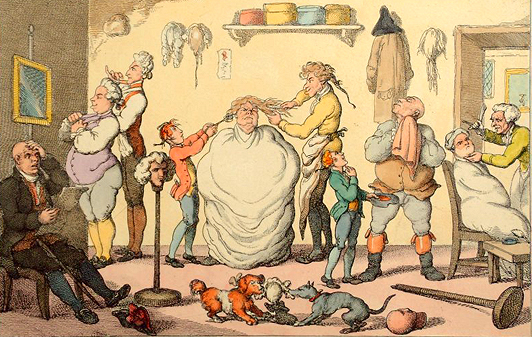
Eighteenth-century wig and barber shop.
One of the things that has made studying the eighteenth century (rather than contemporary literature, as was my original specialization when I first entered grad school) absolutely fascinating is all the amazing nuggets of historical information that I've dug up while doing research.

Many people don't know just how many things that we take for granted as modern inventions (like dildos or condoms) actually have long historical roots. The reverse is also true: there are many bizarre historical facts and beliefs that we have forgotten or, perhaps, chosen to forget, because they became outdated (like the practices of using mouse fur to make fake eyebrows or mercury to "cure" syphilis).

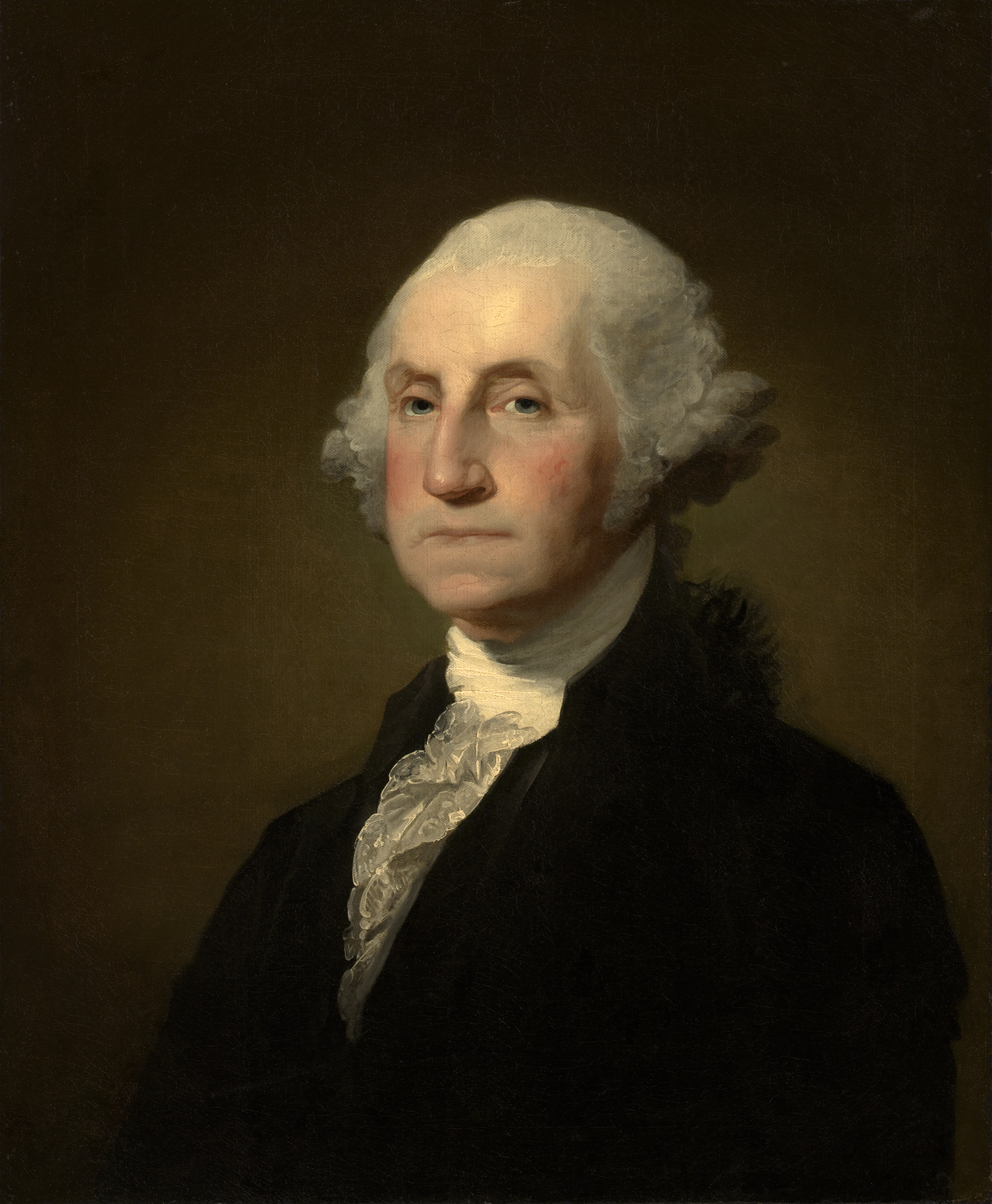
America's famously clean-shaven
founding father, George Washington.
While researching concepts of the gendered body in the eighteenth century, I ended up reading up quite a bit on beards, facial and otherwise. It took me some time to realize that although characters mention facial beards in eighteenth-century works (like Moll, in Defoe's  Moll Flanders), the beard itself was unfashionable in the eighteenth century. The more I looked, the more I came to realize that clean-shaved-ness was expected of men for nearly the whole century. Portraits of all the King Georges, the American "Founding Fathers" and many other noted luminaries of the time portray men always clean shaven, though they do, occasionally, include a five o'clock shadow.

Some forms of facial hair, like the mustache, were almost always popular among military men, but overall, even in the military, men were expected to have a razor and keep up with shaving--or to make time to go to a barber. While the beard, as described by historian Will Fisher, was hugely popular in the Renaissance, to the point that it was a defining characteristic of mature masculinity, and mustaches and mutton chops are the calling cards of the Victorian period, the eighteenth century was almost completely facial-hair free.

The ability to grow a facial beard, however, was significant in the eighteenth-century European cultural imaginary, as it came to be thought of as an essential aspect of the white man's supremacy over other races. Eighteenth-century naturalists like Francois Bernier and Richard Bradely used the relative beardedness of different peoples to identify and classify different races. The beard-growing Europeans were "naturally" superior to the beardless Asians and native peoples of the Americas, and their practice of shaving made them superior to the "unkempt" bearded men of the African continent.

In Peter the Great's Russia, Peter himself imposed a "beard tax" on upper-class men who did not shave in hopes of moving Russia further toward the "civilized" West, further associating shaving with being evolved and Enlightened. (Though it is worth noting that both Henry VIII and Elizabeth I also levied beard taxes in England in earlier periods.)

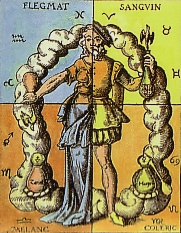
Medieval illustration
of the 4 humors.
Of course, the inability to grow facial hair was also thought of as yet another sign of why women were inferior to men. According to Linnaeus, who came up with this theory based on the theory of the humors, men were "dry and hot," and the excess heat in the body manifested in either sperm or hair. Facial hair was therefore caused by the heat of reabsorbed semen in the male body. Interestingly, bearded women were therefore quite threatening in this hierarchy, as they sported hair that was supposed to belong to the male sex exclusively.

Similarly, women who were independent, powerful, intelligent or self-sufficient were also often thought of as "bearded." Immanuel Kant, for example, invoked the beard in his attach on learned women like the classicist Madame Dacier or the physicist Emilie du Chatelet, citing that women like them "might just as well havea  beard, for that expresses in a more recognizable form the profundity for which she strives." Actual bearded women, however, were dismissed as unfeminine, while the whiskers of postmenopausal women were explained through the Galenic model of reabsorbed bodily fluid--the fluids no longer expelled through menstruation reformed into facial hair.

Also of note, in eighteenth-century narratives of cross-dressing women, many women who tried to pass as men, like the female soldier Hannah Snell, had to figure out how to distract others from their lack of facial hair. Several of them compensated for this lack by soliciting the desires of other women, thus appropriating yet another kind of "beard."