Showing posts with label legs. Show all posts

Wednesday, July 2, 2014

Cross-Dressing Ladies: Maria Edgeworth’s Harriet Freke

Frontispiece to a 19th century
edition of Belinda.
Maria Edgeworth’s Belinda is by far one of my favorite eighteenth-century novels—though, admittedly, it is technically not an eighteenth-century novel at all. The first publishing was in 1801, and subsequent edits and publication dates lead Belinda even further into the early decades of the nineteenth century. It is undeniable, however, that Belinda, in topic, approach and tone is very much an eighteenth-century novel.

 Belinda is a complex work that starts out, seemingly, quite conventionally. The novel purports to tell the story of Belinda, a young lady searching for a suitable suitor. Her aunt has attached her to the fashionable Lady Delacour in London, in the hopes that through this connection, Belinda will meet the perfect suitor. Very quickly, however, the reader cannot but admit that Lady Delacour is, in many ways, much more interesting than the eponymous heroine of the novel. Lady Delacour is magnetic, beautiful and witty—and she has a fascinating back story about how she received a mysterious wound on her breast. It happened, in fact, when she was out in men’s clothes, about to duel with another woman with pistols. For more on Lady Delacour’s breast and her bosom friendships, look here.

The brains behind this whole ordeal turns out to be none other than Lady Delacour’s former bosom friend Harriet Freke, who regularly cross-dresses and enjoys playing tricks on just about everyone. Mrs. Freke, whose own name pronounces her strange proclivities, has “bold masculine arms” with “no conscience, so she was always at ease; and never more so than in male attire, which she had been told became her particularly. She supported the character of a young rake with such spirit and truth, that … no common conjurer could have discovered anything feminine about her.”

At one point in Lady Delacour’s reminiscences, she recounts how a young man jumped into a  coach with her. After the initial shock, she recognizes the young man’s laughter and realizes that this “young man” is in fact her friend Mrs. Freke. Mrs. Freke then recounts merrily of the day’s adventures: “‘Where do you think I’ve been?’ said Harriet, ‘in the gallery of the House of Commons; almost squeezed to death these four hours; but I swore I’d hear Sheridan’s speech to night, and I did…Fun and Freke for ever, huzza!”’

Lady Delacour’s eventual betrayal at the hands of her “bosom friend” Mrs. Freke, as well as the latter’s joy in causing her—and nearly everyone else—pain, casts her as the main antagonist in the novel. She plays tricks on Juba, the black servant of Mr. Vincent (one of Belinda’s suitors), as well as on Lady Delacour, leading the latter to believe that she is haunted. Additionally, Mrs. Freke attempts to turn Belinda against her friend; when this fails, she turns her attention to another young lady, a Miss Moreton, whose reputation is spoiled simply by keeping company with Mrs. Freke.

Towards the end of the novel, Mrs. Freke, in attempting to spy on Lady Delacour, is caught in a bear trap while “frolicking” in men’s clothing: “Mrs. Freke’s leg was much cut and bruised; and now that she was no longer supported by the hopes of revenge, she began to lament loudly and incessantly the injury that she had sustained. She impatiently inquired how long it was probably, that she should be confined by this accident; and she grew quite outrageous when it was hinted, that the beauty of her legs would be spoiled, and that she would never more be able to appear to advantage in man’s apparel.”

Maria Edgeworth
Harriet Freke is conventionally read as the antagonist who gets what she deserves, while Lady Delacour eventually repents of her worldly ways, reunites with her daughter and husband, and even manages to find a good husband for Belinda. Meanwhile, Mrs. Freke must give up her cross-dressing ways and find new ways of playing tricks on people. I’ve always found this reading of Belinda a bit reductive, however. Though Mrs. Freke is certainly not a positive character by any means, even Lady Delacour manages to feel pity for her when she is injured. Further, it is only the doctor’s opinion that Harriet Freke will not “appear to advantage” in men’s clothes after her injury.

The doctor’s opinion also glosses over the fact that cross-dressing allows Mrs. Freke much more than simply the option of “looking good” and exposing her legs. (For more on sexy lady legs, see my previous post on the topic.) Cross-dressing gives Mrs. Freke freedom, especially freedom of movement. Like Hannah Snell and other female soldiers, female pirates, and female husbands, cross-dressing allows Mrs. Freke to go where women usually dared not.


By making Mrs. Freke a cross-dresser, Edgeworth has complicated rather than condemned her character. After all, Lady Delacour cross-dresses in the novel as well—and so does Belinda’s lover, Clarence Hervey. Additionally, the novel is full of masquerades and even some mistaken identities. The marriage between Juba and the English farmer’s daughter (a subplot that was cut in subsequent printings) further suggests that the world is not just “black and white”; there are many shades of gray in between, not all of which are wholly evil or wholly good.

Tuesday, June 17, 2014

Leggy Ladies: 18C Attitudes Towards Legs

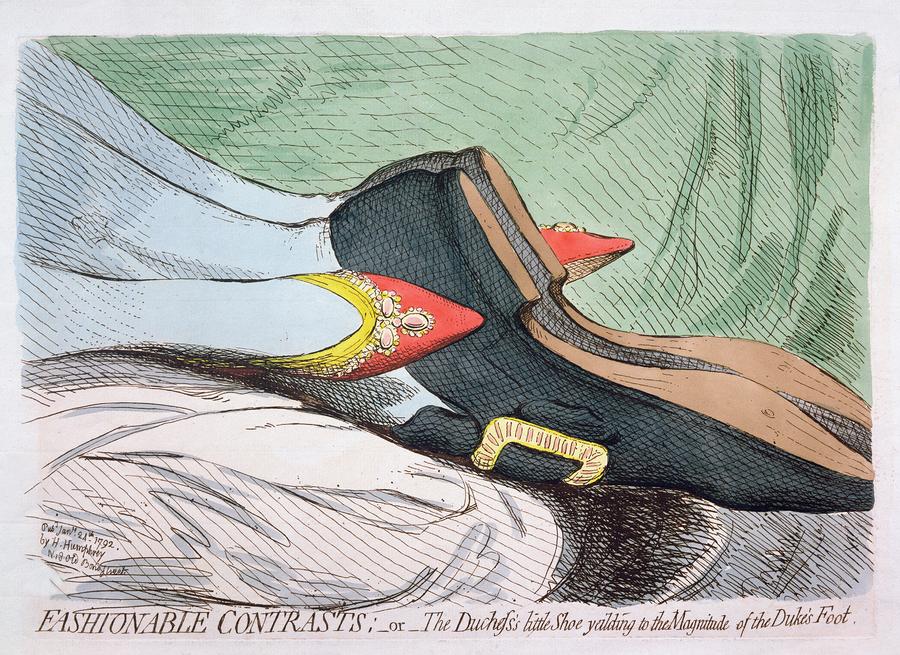
James Gillray's "Fashionable Contrasts" explicitly channels sex through legs & feet.
Gillray's cartoon depicts
ladies of questionable virtue
with their legs showing
from under their skirts.
Eighteenth-century dress, as most of us know, required women to wear long skirts, petticoats, and/or dresses to cover up as much of their legs as possible. A “short skirt” was one that revealed a lady’s ankle(!), and ladies who showed leg were considered titillating, inappropriate, or downright immoral. On the other hand, women who cross-dressed were often admired for their show of a “well-turned leg.” A quote from Bernard Mandeville describes this double-bind perfectly:

If a woman at a merrymaking dresses in Man’s clothes, it is reckon’d a Frolick amongst Friends…Upon the Stage it is done without Reproach, and the most Virtuous Ladies will dispense with it in an Actress, tho’ every Body has a full view of her Legs and Thighs, but if the same Woman, as soon as she has Petticoats on again, should show her Leg to a Man as high as her Knee, it would be a very immodest Action, and every body will call her impudent for it.
Peg Woffington, here as
"The Female Volunteer," was
often admired for her
luscious legs.

In fact, what made women’s legs so titillating was precisely the fact that they—and the crotch at the top of the legs—were hidden, invisible and unmentionable in normal dress. According to costume historian Ann Hollander, while men’s clothing tended to emphasize the body and “demonstrate the existence of a trunk, neck and head with hair, of movable legs, feet and arms, and sometimes genitals,” women’s clothes and particularly the skirt, which “hid women from the waist down and thus permitted endless scope for the mythology of the feminine, had become a sacred female fate and privilege, especially after it became firmly established as a separate garment.”

The separation of the legs seemed to allude, all too clearly, to the genitalia between them, making breeches on women an overtly sexual spectacle. Even actresses had to contend with the condemnation of eighteenth-century moralists on the topic of breeches parts and travesty, while all women were aware that the showing of legs was an immoral act often associated with prostitution.

Oh Henry!
Look at your
bulging...calves!
This is not to say, of course, that men’s legs were not sexualized in one way or another, either. Eighteenth-century texts and earlier Renaissance texts emphasize slim ankles and bulging calves as being the definition of a graceful gam in a gentleman. Henry VIII, for example, was revered for his muscular calves, a fact remarked on by the Venetian ambassador in 1515: “His majesty is the handsomest potentate I ever set eyes on…with an extremely fine calf to his leg.”

The difference between men’s and women’s legs seems mostly to be that an exposed male leg was accepted and expected in the eighteenth century, while the appearance of a feminine leg was, in most cases, not. Women who cross-dressed were seen as transgressors of gender codes, but, if they were attractive enough, then their leg exposure was also acceptable. All women who cross-dressed or even momentarily donned trousers to, for example, ride more comfortably on horseback (like the real Queen Caroline Mathilde who I wrote about last week!), were able to take advantage of the greater mobility that trousers afforded.
 
The trousers of female pirates Ann Bonny and Mary Reade in this engraving
suggest a level of comfort and mobility inaccessible to women in dresses and petticoats.

Thus, trousers were always, in a sense, a way for women to rebel, for they signaled independence, freedom, and increased mobility. This doesn’t mean that women in trousers weren’t sometimes co-opted by patriarchal projects designed to recruit men to the army, to arouse men sexually, or to put female bodies on display for consumption. Pants and legs are much more complex signifiers in the eighteenth century than just that; the images I include here as well as the remarks by Mandeville indicate the multifaceted, at times ambiguous nature of the female leg, and legs more generally, in eighteenth-century English society.

Isaac Cruikshank's cartoon satirizes the growing interest in ballet at the end
of the 18th century and its exposure of female legs...and other bits.