Showing posts with label eighteenth-century. Show all posts

Friday, March 4, 2016

Playing High in the Eighteenth Century

Whenever I teach eighteenth-century literature, I find I have to explain certain aspects to my students about daily life in this time period. The cost and upkeep of a coach and horses, for example, is hard to conceive of in a time when most people in the US own a car—or know someone who does. Similarly, the discrepancies between how much a maid or vicar might earn a year versus the yearly income of a Mr. Bingley or a Mr. Darcy is also difficult to comprehend. How could some people live on a mere fifty pounds a year, or even just five pounds a year, in the case of a servant, when others had 5,000 or 10,000 pounds a year? Even more confounding can be the notion of “debts of honor” between friends and the widespread custom of playing cards for money among the social elite.
Fashionable men and women play "Pope Joan."
            Our class recently read Daniel Defoe’s Roxana, and while Roxana lives in the Pall-Mall, she becomes the hostess of masquerade balls and fĂȘtes that last all night. In the wee hours of the morning, the gentlemen “play’d high, and stay’d late.” A couple pages later, we learn that the gentlemen who join in the card games play high enough that their tips to Roxana’s maid, Amy, who attends them, amount to 62 pounds—anywhere from 2-5 years’ worth of wages for a maid. At the end of the novel, when Roxana’s daughter Susan tracks her down, she recounts various details that link Roxana to her exploits in the Pall-Mall. Of these is the memory of her gaming tables, which Roxana now admits gave the masquerade balls at her apartment a rather unsavory flavor: “her own Account brought her down to this, That, in short, her Lady kept a little less than a Gaming-Ordinary; or, as it wou’d be call’d in the Times since that, An Assembly for Gallantry and Play.” To the middle-aged Roxana, her former role as the mistress of a gambling establishment is nearly as detestable as her affairs with various men.
            Yet, gambling and playing high at cards was certainly not just the provenance of men. Alexander Pope’s “The Rape of the Lock” recounts an intense game of ombre in which the heroine Belinda wins the game:
                                    The King unseen
Lurk’d in her Hand, and mourn’d his captive Queen.
He springs to Vengeance with an eager pace,
And falls like Thunder on the prostrate Ace.
The Nymph exulting fills with Shouts the Sky,
The Walls, the Woods, and long Canals reply.
Although the poem does not explicitly mention money being lost and won, card playing was almost always for money in this time period. Women did not usually gamble in public clubs (the “ordinaries” that Roxana mentions), but even in card games between friends, money was always at stake (think of all the games of whist in Jane Austen novels—always for money). In the later eighteenth century, many society women hosted games of “faro” on their faro tables, and some of them were even accused—and found guilty—of stealing from the bank! The case of Mrs. Albinia Hobart, later Countess of Buckinghamshire, who was found guilty of doing just that, and her friend Lady Elizabeth Luttrell, may have been the inspiration for Mrs. Harriet Freke and her friend Mrs. Luttridge in Maria Edgeworth’s Belinda. At the end of the novel, the two women are exposed for having cheated the men who come play at faro on their tables.
In reality, Mrs. Hobart was just fined 50 pounds--though the judge threatened her
with flogging. 
Georgiana Cavendish
            In Belinda, gambling itself is seen as the addictive vice that we understand it to be now. Throughout eighteenth- and nineteenth-century novels, we see the representation and condemnation of gambling and playing high. While it is often the men, like Mr. Vincent in Belinda or Fred Vincy in George Eliot’s Middlemarch, who get in trouble for gambling their money away, women could rack up debt as well. Georgiana Cavendish, Duchess of Devonshire, was, at one point, in debt for in excess of 100,000 pounds (remember, Mr. Darcy, who is ridiculously wealthy in Austen’s Pride and Prejudice, has a yearly income of 10,000!). As it turned out, the Duchess had been tricked by a notorious cheat, who had lent her money only to multiplied her debts in the span of just three months. The Duke, Georgiana’s husband, almost divorced her over the gambling and her debts…
            Gambling was certainly thought to be a vice and a waste of time—and immoral—by many in the eighteenth century. And yet, it was commonplace. While paying to play in a gambling establishment seems de rigour, what I often find difficult to understand is that friends “played high” against one another even in “friendly” games of cards. Those debts were considered “debts of honor,” i.e. debts that must be paid ahead of bills to the grocer, the tailor, or any other merchant who might actually be relying on that money to feed his own family. In Robert Brinsley Sheridan’s The School for Scandal, Charles Surface gambles his money away to his friends; when he sells off the family portraits and library unsuspectingly to his own Uncle Oliver for a hundred pounds, he uses it to gamble with even as merchants await to be paid: Rowley the servant to Oliver: “I have left a hosier and two tailors in the hall, who, I’m sure won’t be paid, and this hundred would satisfy ’em!”

            The only way, perhaps, to understand the eighteenth-century penchant for playing for high stakes and paying one’s debts of honor is to think of the people who do so as we do now of celebrities. Who else would be so needlessly extravagant, so heedless of duty, so uninterested in integrity? It is no wonder that in the novels of Frances Burney, for example, the heroines, like Camilla, must be warned and forewarned several times by friends and family not to “fall in with the wrong crowd.” The “cool crowd” of the eighteenth century liked to spend money excessively and heedlessly, in a manner that most people, even those who achieved financial stability, could not keep up with for very long.

Thursday, June 25, 2015

Adventures in Professionalization: Library Research at the Folger

As I mentioned in my previous post, I did some research at the Folger Shakespeare Library this month. In addition to learning many interesting facts and foibles about Elizabeth Inchbald, whose papers are owned by the Folger, I also had my first experience in traveling to a specialized library.
The Folger Shakespeare Library:
from the outside, it looks like an Italian Fascist masterpiece, ha ha.
Well, that is not exactly true…I traveled to the Thomas Fisher Rare Books Library at the University of Toronto while working on my MA thesis on Margaret Atwood. That, however, was eight years ago, and did not involve getting a reader card—or tea and cookies at 3pm every day!

In any case, it has been a long time since I traveled to a library or archive to do specialized research, and my experience at the Folger was extremely positive. Of course, there are always various discomforts that attend such research: uncomfortable chairs and tables too high for typing comfortably on a laptop; only using pencils; freezer-level A/C, etc. On the other hand, the Folger has many aspects specific to itself that made it a particularly pleasant scholarly experience. 

As mentioned before, the Folger readers and staff have the option of tea, coffee and cookies at 3pm every day. Most folks go to the afternoon tea break, and it’s a wonderful opportunity for meeting the other readers at the library. You never know who you will run into! I had the pleasure of meeting, among many others, Jack Lynch from Rutgers, whom I already follow on Twitter but had never had the opportunity of meeting in person, as well as Lara Dodds, from Mississippi State and on whose roundtable I will be speaking at the MLA in January! It’s a small world in academia, as usual.

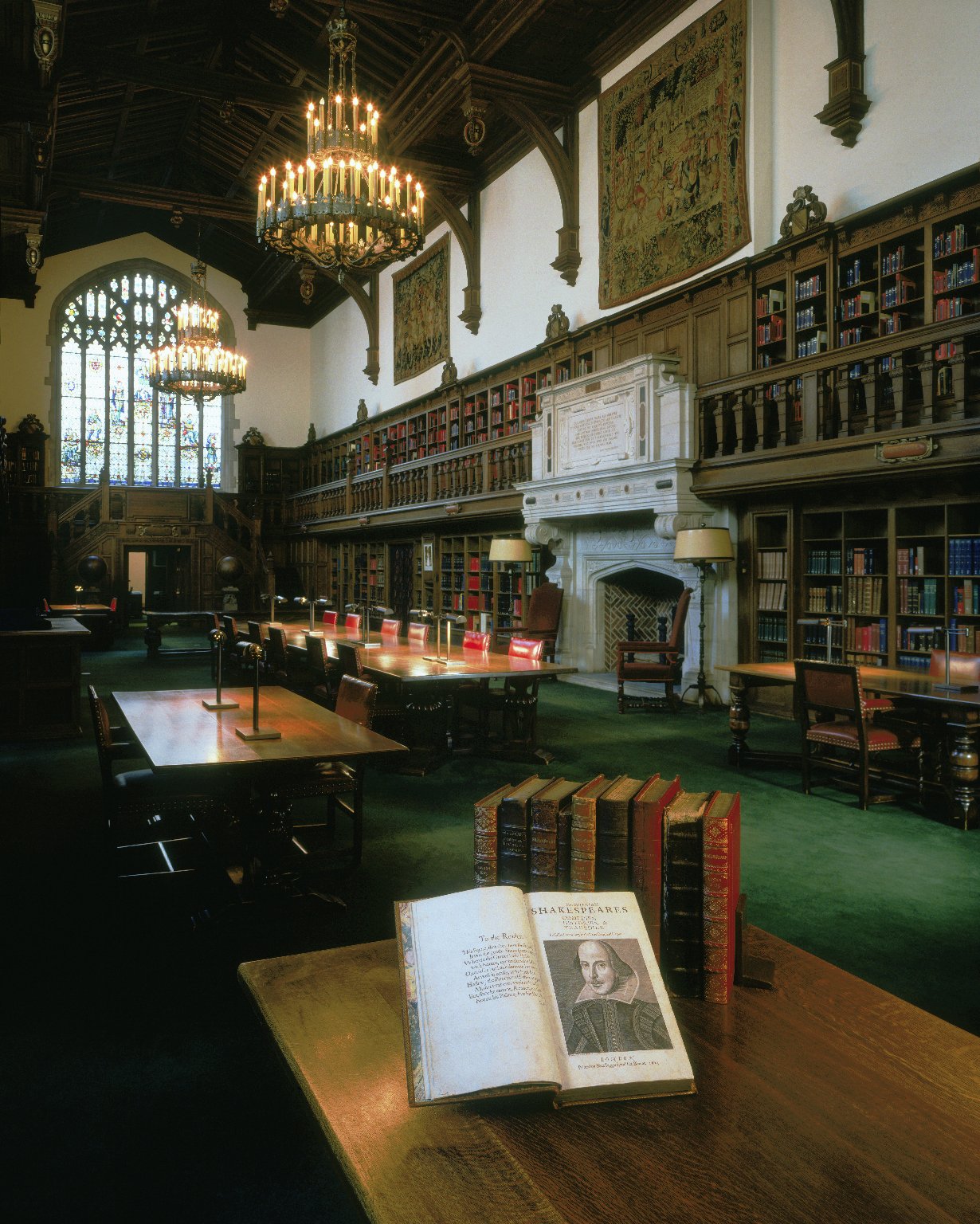
The beautiful reading room.
Aside from tea and cookies, the Folger reader room is beautiful and inspiring. Part of it looks like the library of an Elizabethan gentleman, complete with lots of dark wood, shelves of hardbound books, and leather-and-wood chairs that look like they are right out of a museum. There are busts of Shakespeare, stained-glass windows, and decorative motifs that would not look out of place in a Gothic church.

The librarians are very helpful, and although the website says that it can take up to 90 minutes to fetch rare materials, I never had to wait more than a half hour. I suppose it helps that I was there in summer and not during the school year. Still, I found the library fairly easy to use, quiet, and pleasant to work in.


My research itself was interesting, too, although I didn’t know how much useful information I would find. Doing archival research is very much a situation in which you don’t know what you might find or how useful it might be. For now, I think I’ve gotten what I need for my book project, but it’s comforting to know that I can return to the Folger whenever I’m in town again and take another look.
Going to the Folger is a great excuse to visit one of my favorite cities!

Sunday, March 29, 2015

City of Angels: Reflections on ASECS 2015

A week ago I had just gotten back from LA and the annual meeting of the American Society for Eighteenth-Century Studies (ASECS). Last year’s meeting was in Williamsburg, Virginia, so it’s a bit hard to beat, from a historical perspective, though Los Angeles has its own charms, including delicious ethnic food, glittering sky scrapers, funky bookstores, and lots of big city glamour.
The famous/infamous Westin Bonaventure hotel.
Of course, I don’t really go to ASECS meetings for the glamour—unless you count the fashion styles of some of our most prominent scholars as “glamour,” which I do. President Kathleen Wilson gave her presidential address wearing a canary-yellow confection that would not have been out of place in Megan Draper’s closet on Mad Men, while John Richetti and Srinivas Aravamudan duked it out sartorially for the title of best-dressed dandy. I’m still deciding whether pink socks (John) trumps polka dot scarf and pork pie hat (Srinivas).

Scholarly fashion aside, this year’s conference was another personal success—and not just because I both presented a paper and chaired a roundtable, thought that was part of it. It was my fifth time at the annual meeting, which meant that there were ever more familiar names and faces to reconnect with, many wonderful folks from Twitter to finally meet in person, and an even greater sense of scholarly community to experience. Being the lone eighteenth-centuryist in my department in Texas, I enjoyed being surrounded by eighteenth-centuryists, even if I don’t always see eye-to-eye with them all.

My first ASECS was the meeting in Vancouver, and I still remember how wonderful it felt to share the first forays into my dissertation project with other people and get positive feedback. Last week, it still felt good to get positive feedback on the paper I gave and later on the roundtable I had assembled and chaired. Validation is an important part of the conference experience: our task is often a lonely one, and we need conversation and external validation in order to keep us going.

At the same time, conferencing also opens our eyes or, less dramatically, simply reminds us that there are people working in the same time period and perhaps even on related projects whose approach is diametrically opposed to our own. If you are like me, and you try to go to a couple of panels every day, then you are likely to hear papers that seem boring, irrelevant, or even wrong to your personal point of view and methodology. Those moments are difficult because they remind us that our own methods and objects of study are not the only ones out there; we are part of a larger constellation of projects and questions and areas of study that thrives on difference, not sameness.

Aside from the more esoteric side of conferencing, there is also a very pragmatic side. We come to conferences to meet people, not just ideas. I was fortunate enough to take advantage of the “Speed Mentoring” offered at this year’s conference, and there I met Kirsten Saxton, who, in about half an hour, listened to my questions, gave me great advice, and made me feel more confident about the next step in my career. I thus began my conferencing at ASECS with the sense of the humanness of conferences. I also ended it that way when I attended the Women’s Caucus annual luncheon on Saturday.

At the luncheon, in addition to getting to reconnect with my outside reader and wonderful mentor Kristina Straub, I simply basked in the sense of being surrounded by intelligent, capable, friendly, scholarly women, whose presence reminded me of how central women’s and gender studies is to my work and my sense of myself as a literary scholar.

My web of connections had some extra sparkle this year because of the presence of several people from my doctoral institution, Stony Brook University, including President Kathleen Wilson. Kathleen has always been a wonderful scholar, but many people might not also know that she is an incredibly generous friend, mentor, and colleague.

Before I get too gushy though, I will finish up my reflections on some of the panels I attended—and I tried to attend as many as my travel-addled brain could handle. Thursday I presented on the “Queer Richardson” panel, and it was an excellent set of papers, if I do say so myself. I spent the afternoon volunteering at the Women’s Caucus book sale table, which meant getting to chat with various attendees to who stopped by to take a look at the books for sale, including other SBU Alums, Devoney Looser and Jenny Frangos.

On Friday, I attended a panel on the role of missionaries in cultural and political developments, mostly because a colleague from my home department was presenting. I ended up learning a lot on a topic that I didn’t know much about, something I always appreciate. Kathleen’s presidential address on producing Sheridan’s plays in colonial milieus was fascinating, and I followed it up with the transgender studies in the eighteenth-century panel. Chris Roulston’s paper on Anne Lister was tender, reflective, and inspiring.

Saturday I took the morning off to catch up with some friends; after the Women’s Caucus luncheon I attended one more session: a workshop run through the “Re-Enlightenment Labs” project (Cliff Siskin and William Warner) which was interesting in part because it was a workshop, not a panel or roundtable. Between this “lab” and earlier discussions at our table at the luncheon, I’ve started thinking about how we might shake up the “usual” modes of conferencing. Even if the topic of the “lab” was not something I would have chosen myself, I found the idea of having a discussion (rather than just listening to others read papers) fascinating and refreshing.

I finished out Saturday in LA with a trip to The Last Bookstore and a delicious tapas dinner with some amazing people. I strolled over to the Walt Disney Concert hall, shopped for Andy Warhol postcards at the MOCA shop, and tried to ignore the urine stench in Pershing Square. It seems that the seedier side of downtown LA is still there, just a few blocks away from the sleek shine of the Westin Bonaventure and the stately hush of the LA public library.

Although conferencing is a heady mixture of inspiration, exhilaration, exhaustion and, at times, disappointment, it always leaves me reinvigorated in the end. I return to my own little patterns and habits, but my thoughts trace new paths and my research takes on new meaning.

Walt Disney Concert Hall.
I had to do a little sight-seeing at least!


Wednesday, February 4, 2015

What’s In a Name?: Periodicity and How We Study Literature

One of the panels for next year’s MLA Convention considers the relevance and repercussions of naming the time period that we study, specifically the eighteenth century:

Naming the 18th Century
Special Session
What's at stake in naming this period "long" (1660-1830), "short" (1715-1789), early modern, Enlightenment (etc.)? What's its role in the new MLA? 300-word abstracts by 15 March 2015; Dustin D. Stewart (dustin.d.stewart@gmail.com) and Joshua Swidzinski (js3683@columbia.edu).

Literary studies logic:
Start with the old stuff.
It is an interesting question, one that many scholars side-step in their research. This issue is not specific to eighteenth-century literary scholars and historians, though that is the time period I am most familiar with. Overall, the study of literature in English is overwhelmingly still dominated by geographical and chronological divisions: American Literature is separate from English Literature; both of which are at times excluded in courses dedicated to Global Literatures in English. Similarly, most doctoral programs still emphasize periodicity through the demand that potential scholars declare which time period is “theirs.” Oral examinations and dissertation projects are similarly expected to be tied to specific time periods in preparation for the job market (or what’s left of it), in which many scholars still hope to be hired for a time period-specific job.

The idea of the period-specific scholar is both a new invention and an old one, and one could probably make a convincing argument for the continued importance of focusing on individual time periods versus becoming a “Generalist”—a designation that is increasingly popular on job postings yet remains suspiciously bland and non-rigorous in the minds of many scholars.

Anthologies suggest distinct time periods...but is that such a good idea?
Literary survey courses often present literature and literary history to students in a chronological order, neatly dividing (as the Norton splits often do) British literature into six distinct and orderly time periods of literary output: Medieval; Early Modern; Restoration and Eighteenth Century; Romanticism; Victorian; 20th Century and Beyond. But as we read, it is impossible not to note that there might be many different ways to consider British literature.

We could consider it via genre, theme, style, topic, or in even more arbitrary ways, such as alphabetically by the title of the work or author’s last name. Even with such an arbitrary organizational method, we could probably find a way of making sense of these juxtapositions. Consider a course on “B” literature, and the fascinating juxtapositions of Borges, Bulgakhov, Bronte and Balzac.

Of course, one of the most pressing reasons for reading works chronologically, aside from its seeming “logical” to go “in order,” is because in literary studies, authorial output is often influenced by what the author read him/herself—and those are, of necessity, works written earlier or concurrently with his/her own. The idea of being able to trace an author’s reading history and to find those influences in a work is a powerful and appealing one. Similarly, in our scholarship, we often imagine that by studying by time period, we may uncover changes in style, topic, and form that might otherwise escape our discerning eye. Scholarly claims often focus on making an argument for how a certain kind of reading shows us something about the time period it was written in or the ideas circulating at the time. Certainly this is evident eighteenth-century studies, where the eighteenth-century is the “first time” that we find an example of X; or Y trend in this time period indicates that such-and-such was changing in the eighteenth-century.

It's comforting to think of history as progress and improvement...
but that's not always the case.

Projects relating to the Enlightenment and Enlightenment personhood are also very of-the-moment. Various claims have been made for the eighteenth century, the long eighteenth century, the Enlightenment, the Neoclassic period, the Age of Johnson, the Age of Satire, late Early Modern period…the list could go on. We ponder why certain styles of poetry became popular while others receded; we theorize the rise of nationhood at this time; we make arguments as to the changing role of women, class divisions, sexuality, and race. But in many ways, these arguments seem constrained by our emphasis on the time period rather than liberated or enhanced by it.


Is the eighteenth century truly the Age of Satire?
Why not the 19th century?
Or the 20th century?
My own research focuses on the body, desire, and, more specifically, female cross-dressing. It’s hard to write about female cross-dressers of the eighteenth century and their representation in literature without running into various claims that such representations “reached a peak” in the eighteenth century or that the cross-dresser was “socially accepted” in the first half of the eighteenth century, only to become socially undesirable by the end of the century.

Such claims seem, at least to me, to construct a false history of the female cross-dresser and her role in British literature. To look at female cross-dressing only in eighteenth century literature is to ignore the role of cross-dressing in medieval and early modern England as well as its continuing role in nineteenth-century culture. Similarly, to look at female cross-dressing only in an English context or even an English-speaking context is to risk making claims about this phenomenon that are incomplete. Female cross-dressers were not limited to an English context, yet most scholars would find it difficult to find a way of writing about these representations in other cultures unless they were in a Comparative Literature program.

To bring up the issue of Comparative Literature means also having to consider literary studies in different languages. Literary studies in other language—Spanish or French or German, for example—may have other kinds of chronological divisions in their time periods. Periodicity is, after all, tied to certain time periods that have a distinctive relationship to the history of the country that they represent.

I don’t mean to sound as if I’m only throwing up roadblocks here. I love what I do and what I study; I love being an eighteenth-centuryist. I enjoy going to ASECS, learning about the eighteenth century, and spreading my love of it to everyone I know. At the same time, I try not to forget the limitations of my methods and thinking. It’s important for our students to know that no time period is homogenous and that our world is never just progressing forward; sometimes we’re marching backwards. The linear progression of history and creative output is an organizing fantasy, one that may need to be rethought as the modern university changes and one that we cannot, should not ignore in our own research.

Thursday, December 4, 2014

Happy Anniversary—to Notes & Petticoats!

It’s been just over a year since I started the blog, so I figure it’s as good a time as any to reflect on the blog and, more generally, my life as a scholar online.

When I first heard about academic scholars in the humanities using Twitter to connect with other scholars, I couldn’t imagine anything stranger. Even now, when it seems the most natural thing to me, I mention it to other non-twittizens, and they bristle a bit. I can see them thinking of me in a different light—I’m one of “those people”; I’m a tweeter!

While I’m sure I could very easily do much of my research without every foraying into the world of e-cademia, I have found so many advantages to being on Twitter.

I have become exposed to all sorts of scholars whom I wouldn’t otherwise have heard of, merely because they mostly write about the Victorian period or the Early Modern period. Or they are from some other discipline that I wouldn’t otherwise come into contact with. And yet their links, thoughts, comments and responses have often brought some interesting issues to my attention.

Though Twitter I have also found more 18th-century blogs as well as blogs about literature, culture, representation and the body. And occasionally these blogs have actually revealed to me texts, images or historical personages about whom I have heard but didn’t know where to find this information.

I have even met people on Twitter…and then met them in real life—at conferences!

And finally…without Twitter, the readership of this very blog would be much lower than it currently is. I have found that the two platforms complement each other, allowing my ideas and words to become part of a larger conversation—even if I only post once or twice a month.

Even at only a low-to-moderate rate of publication, however, I’ve managed to write about female cross-dressers like the real-life Hannah Snell and the fictional Harriet Freke...

I’ve written about films set in the eighteenth century, like A Royal Affair

I’ve explored issues of pedagogy, such as teaching eighteenth-century women poets and how to approach teaching literature survey courses

I’ve even commented on issues of professionalization, such as conferencing successfully and top interview questions at job interviews.

Finally, I’ve had the opportunity to make connections between the 18th century and our own time period and culture. I’ve discussed bearded women, strong female protagonists, racial representation, and…well…pockets!

The blog form allows for a variety of topics, from the serious to the light-hearted. It also encourages interaction and discussion and open-endedness, as opposed to more traditional forms of academic writing (the dissertation, the journal article, the book), which are about one person making a clearly-defined and supported argument, whose reviewers may engage with the text months or even years after.

A recent article by Anne Helen Petersen, who left academia to write for BuzzFeed, discusses some of these publication issues. Petersen notes that one of the aspects of journalism that she enjoys is that when she writes something, thousands of people can read it—for free—as opposed to academic publications, which are usually only read by other specialists in the field or the occasional undergraduate working on a paper and are often inaccessibly priced.

While in many ways I agree with Petersen, I believe the academic blogosphere is opening up an increasingly-rigorous, exciting, and inclusive space in which to discuss our scholarship and its relevance to the world around us.


So…thanks for reading! I’m looking forward to another year of musing, writing, and tweeting!

Thursday, November 6, 2014

Cropped Out of History: At the Margins of Culture

Currently the Yale Center for British Art is featuring an exhibit called, “Figures of Empire: Slavery and Portraiture in Eighteenth-Century Atlantic Britain.” The idea for the exhibit started when curators at the gallery began examining William Hogarth’s 1735 painting, “A Family Portrait,” and they noticed a black hand creeping into the portrait of an otherwise lily-white family of middle-class eighteenth-century Brits.
 
Middle left: I've circled the servant's hand in red.
Upon further examination and x-rays of the painting, the researchers discovered that the black servant figure included in the original painting had been later cropped out of it—about 100 years after it was painted.

The metaphorical meaning of this act is impossible to ignore, as slavery, the slave trade, slave histories and narratives, and even the visual representations of slavery and non-whites have been routinely “cropped out” of dominant histories. It matters little whether we speak of history generally, or if we focus on literary history, art history, musical history, or any other discipline. These stories are often at the margins of where we are looking, not to mention that these discussions are still marginalized in the classroom.

What intrigues me, however, is how often the stories of slaves or Africans or persons of African descent, enslaved or not, appear in the background of other narratives or images. Maria Edgeworth’s Belinda, originally published in 1801, contains a black character: Juba, the servant. In the original version of the novel, Juba marries the (white) daughter of an English farmer—but this element of the plot was cut out in subsequent editions. Again, the story, the character was “cropped out.”

In Frances Burney’s The Wanderer, racial masquerade begins the novel. The main character, the “Incognita,” escapes Revolutionary France in borrowed clothing with darkened features. She has darkened her skin to hide who she really is, and the characters she meets in England initially believe that she really is what she appears to be—a person of African descent.

In the novel, one of the characters asks the “stranger,” “What part of the world might you come from? The settlements of the West Indies? Or somewhere off the coast of Africa?...” Her arms and hands are described as “of so dark a colour, that they might rather be styled black than brown…”

Of course, quite soon we learn that the main character is not black at all—she is French, and the darkening of her skin was one of many ways she attempted to conceal her identity. While Burney may initially be asking us to sympathize with an “apparently black” heroine, she does not require this of her readers for very long.
The idea of “blackening” one’s skin or hiding behind a mask of darker skin color is apparent in John Raphael Smith’s pastel portrait “A Lady Holding a Negro Mask.” Historian Kathleen Wilson recently wrote about this image in the ASECS Fall 2014 newsletter. As she points out, there are many ways of interpreting the image. One thing that seems apparent to me in all of these examples is how integral blacks were to British life throughout the eighteenth century. While they may often only appear in the margins of literature or art, the consistent repetition of these images and references suggest that we are only at the tip of the proverbial iceberg.
 
Is she going to a masquerade? Is she happy about it?
Is the painting about race? gender? beauty? identity? all those things?
One interesting project that is working to change how we think of literary history in an American context is the “Just Teach One” project. Initially it began as a project that would aid instructors of Early American literature in teaching less-taught texts—texts that are out of print, difficult to find, or simply unknown. A parallel project has grown out of that first one, focusing on prints and literature of African Americans.

The name of the projects asks us to consider what happens when we make a concerted effort to teach at least one lesser-taught text, or at least one text by an African American who is, presumably, not Frederick Douglass (mostly because his canonicity has become [mostly] established). Their website caters specifically to instructors and aims to provide easily accessible versions of various lesser-known texts.


Many projects concerned with diversity and inclusivity have taken up the idea of moving things, people, and historical moments from the margins and putting them at the center of the conversation. We can only hope that this conversations keep happening and that more and more projects, exhibits, and syllabuses are put in the service of bringing hidden histories to light, of moving issues from the margins to the center. In the end, perhaps we may also find ways to move the conversation away from the binary of center and margin to other intertextual, multivocal, and less hierarchical modes of thinking and teaching.
Johann Zoffany's Family of Sir William Young, 1770.
The detail of this painting containing the African servant/slave is on my edition of Belinda, by Oxford World's Classics.
Interestingly, the redesign of the cover scrapped this image and chose one of a corset.

Tuesday, June 17, 2014

Leggy Ladies: 18C Attitudes Towards Legs

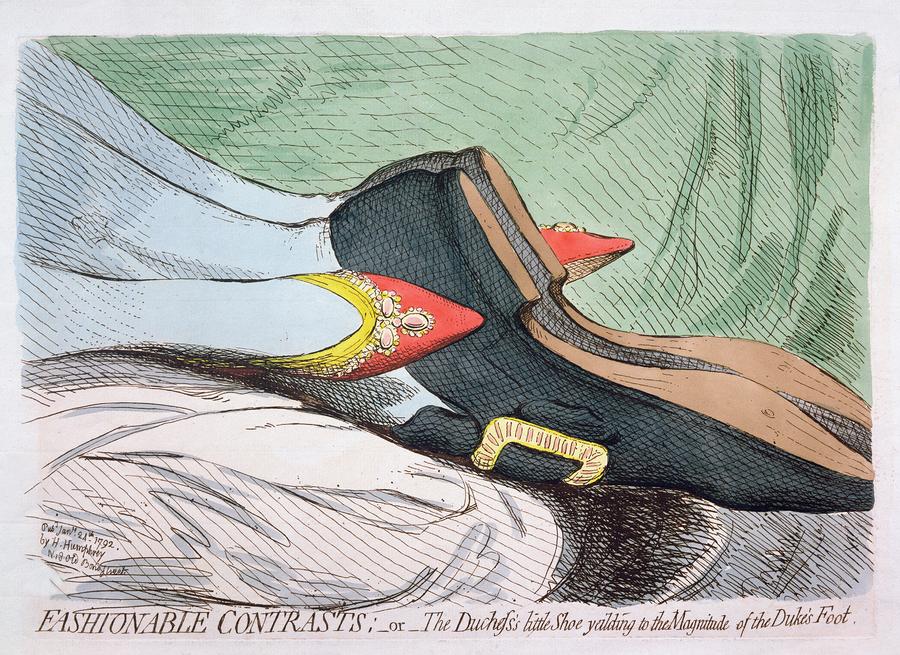
James Gillray's "Fashionable Contrasts" explicitly channels sex through legs & feet.
Gillray's cartoon depicts
ladies of questionable virtue
with their legs showing
from under their skirts.
Eighteenth-century dress, as most of us know, required women to wear long skirts, petticoats, and/or dresses to cover up as much of their legs as possible. A “short skirt” was one that revealed a lady’s ankle(!), and ladies who showed leg were considered titillating, inappropriate, or downright immoral. On the other hand, women who cross-dressed were often admired for their show of a “well-turned leg.” A quote from Bernard Mandeville describes this double-bind perfectly:

If a woman at a merrymaking dresses in Man’s clothes, it is reckon’d a Frolick amongst Friends…Upon the Stage it is done without Reproach, and the most Virtuous Ladies will dispense with it in an Actress, tho’ every Body has a full view of her Legs and Thighs, but if the same Woman, as soon as she has Petticoats on again, should show her Leg to a Man as high as her Knee, it would be a very immodest Action, and every body will call her impudent for it.
Peg Woffington, here as
"The Female Volunteer," was
often admired for her
luscious legs.

In fact, what made women’s legs so titillating was precisely the fact that they—and the crotch at the top of the legs—were hidden, invisible and unmentionable in normal dress. According to costume historian Ann Hollander, while men’s clothing tended to emphasize the body and “demonstrate the existence of a trunk, neck and head with hair, of movable legs, feet and arms, and sometimes genitals,” women’s clothes and particularly the skirt, which “hid women from the waist down and thus permitted endless scope for the mythology of the feminine, had become a sacred female fate and privilege, especially after it became firmly established as a separate garment.”

The separation of the legs seemed to allude, all too clearly, to the genitalia between them, making breeches on women an overtly sexual spectacle. Even actresses had to contend with the condemnation of eighteenth-century moralists on the topic of breeches parts and travesty, while all women were aware that the showing of legs was an immoral act often associated with prostitution.

Oh Henry!
Look at your
bulging...calves!
This is not to say, of course, that men’s legs were not sexualized in one way or another, either. Eighteenth-century texts and earlier Renaissance texts emphasize slim ankles and bulging calves as being the definition of a graceful gam in a gentleman. Henry VIII, for example, was revered for his muscular calves, a fact remarked on by the Venetian ambassador in 1515: “His majesty is the handsomest potentate I ever set eyes on…with an extremely fine calf to his leg.”

The difference between men’s and women’s legs seems mostly to be that an exposed male leg was accepted and expected in the eighteenth century, while the appearance of a feminine leg was, in most cases, not. Women who cross-dressed were seen as transgressors of gender codes, but, if they were attractive enough, then their leg exposure was also acceptable. All women who cross-dressed or even momentarily donned trousers to, for example, ride more comfortably on horseback (like the real Queen Caroline Mathilde who I wrote about last week!), were able to take advantage of the greater mobility that trousers afforded.
 
The trousers of female pirates Ann Bonny and Mary Reade in this engraving
suggest a level of comfort and mobility inaccessible to women in dresses and petticoats.

Thus, trousers were always, in a sense, a way for women to rebel, for they signaled independence, freedom, and increased mobility. This doesn’t mean that women in trousers weren’t sometimes co-opted by patriarchal projects designed to recruit men to the army, to arouse men sexually, or to put female bodies on display for consumption. Pants and legs are much more complex signifiers in the eighteenth century than just that; the images I include here as well as the remarks by Mandeville indicate the multifaceted, at times ambiguous nature of the female leg, and legs more generally, in eighteenth-century English society.

Isaac Cruikshank's cartoon satirizes the growing interest in ballet at the end
of the 18th century and its exposure of female legs...and other bits.


Thursday, April 3, 2014

Professionalization: Successful Conferencing

Going to conferences is an excellent way of learning more about your field, expanding your knowledge in a given area, getting inspiration, as well as meeting people who might help you in your research. More generally, they are important to staying informed of the direction in which things are going in your field, the major issues and ideas coming to the fore, as well as showing others that you are an active researcher.

All of these principles hold true for us eighteenth-century folk, and we are lucky to have some really wonderful conferences in our field. I have been to meetings of ASECS, Northeast ASECS, Canadian SECS as well as Southeast SECS, and each venture has been a success. In part, this is due to the fact that, as I mentioned in my previous post about this year's ASECS meeting in Williamsburg, VA, eighteenth-century scholars are, generally, a friendly and enthusiastic bunch. Additionally, we are well-organized; there is a regional eighteenth-century conference for several different regions in the US as well as several international and author-based conferences. Even if you only went to eighteenth-century specific conferences, you could still probably go to a different conference every month!

As an added perk, many renowned scholars in the field regularly attend these conferences. Rarely do you walk into a room at ASECS without recognizing the names of several people on their name tags from articles and books that you've looked up and read during your research. Of course, how to meet these people and get their help is another question.

Conferences can be daunting, especially if you are a graduate student or a junior scholar. ASECS is fairly large--over 900 people registered for the most recent meeting. How does one navigate a conference successfully? What does it mean to "network" at these functions? How can you still have a good time while you "work"? I've put together some tips here as suggestions for how to make the most of your next conference.

1. It's the people, not the topic. When choosing what panels to attend, make sure to pay attention first and foremost to the people on the panel rather than the topic. If there is a panel on a topic that relates to your research, but you've never heard of the scholars on the panel, it's quite possible that  the panel will be useless for you. Frequently, people present on topics that are new to them; it's possible that you may know more on the topic than someone who is new to it. If, however, you go to panels to hear people whose work and research you know and admire, it is likely you will learn more and gain more useful knowledge and insight into your research, regardless of whether the topic is in your specific area or not.

2. Be a friend, not a fan. When meeting scholars whose works you've read and admired, resist the urge to be a "fan" and compliment the person on past books and articles. Conferences are stressful for all of us, so during breaks between panels or at receptions, people just want to be friendly. Discuss books, movies, the restaurants in the city the conference is held in--but don't be pushy about discussing scholarly topics and research. It can seen counter-intuitive, but trust me, the best way to "network" at a conference is to befriend someone. If you really want to talk research, here's how to do it...

3. Bring up research at an appropriate moment. If you're desperate to get input on your topic from a star in your field, or you just want some face time with someone, there are a couple of different methods for doing this.
     a. Get someone to introduce you. Ask a friend, colleague, or mentor to introduce you to the person in question as someone who does "similar research." Usually this will lead the senior scholar to ask the junior scholar (you!) about what you do. Focus on your topic; again, don't seek to pander, flatter or be a fan. Pretend you are on the same level; remember: at a conference, you basically are.
    b. Approach the person after their talk. It is customary for people to approach scholars after the Q&A on a panel. If there is a line, this may not work. If the line is short, hang in there! At this juncture it's ok to tell someone you enjoyed the talk, it reminded you of x text or theory, or it relates to a project you are working on. If the person responds well, that can lead to further conversations, exchange of contact info, etc.
    c. Approach the person during a reception. If you attended someone's talk but didn't get the chance to talk to him/her afterwards, find the person during a reception. Introduce yourself, mention that you heard his/her talk, and respond to it in some way as in letter b.

In each of these examples, though, keep it brief unless the person you are speaking to asks you questions. If the conversation changes to other topics, go with it or leave and work the room....which brings me to my next point...

4. Go to the receptions and work the room. At receptions it is expected that most people will talk to a variety of people. The first time at a particular conference, you'll probably find a group you like and stick to them, but resist the urge to stay in one corner. This is why it's important to attend a variety of panels, especially your first time at a conference. At the receptions, work your way around the room, talk to people who were on your panel, on panels you attended, or who you recognize from other events. Don't be afraid to talk to people casually at the bar or to pop in and out of conversations. Everyone is doing it, and no one will be offended. If you are in a great conversation with someone, eventually someone else is going to interrupt. It happens! That's why it's important to follow my next tip...

5. Network after the conference, too. If you met someone interesting at the conference, you had a great conversation, you heard an interesting paper--don't let that experience go to waste, especially if you are intent on brokering new contacts and networking. Email those people a week or so after the conference. Don't email the next day, as many people have to travel and then catch up on work and family obligations. Don't wait too long, either, though, as you don't want people to forget you. The ideal time is about 1-2 weeks after the conference. Send a quick email, remind the person who you are and what you talked about, request a copy of their paper or bibliography or offer a copy of yours, whatever. This will help solidify your contact, even if you don't hear from or speak to this person until next year's conference.

Final thoughts: As important as it is to "network" at conferences, don't forget to make friends, too. Real friends--people you enjoy talking to and hanging out with, regardless of what they can "do for you." Remember that eventually senior scholars will retire; you need to have friends and colleagues from your peer group to hang out with, commiserate with, and keep in touch with. It will make your experience more fun (it's always nice to have someone to have dinner with!), more natural and relaxed, and help you out in the long run as well.

Friday, March 28, 2014

Conference Sociability & Sensibility: ASECS 2014, Colonial Williamsburg

This year's convention for the American Society for Eighteenth-Century Studies was held in Colonial Williamsburg last week, and, as usual for me, it was a great success. Of course, the fact that it was in a historically-appropriate location certainly helped; it was decidedly easier to feel that one had magically stepped into the world of the eighteenth century when just a short walk from the conference venue there is an entire village of reenactors wearing full-on eighteenth-century garb! (Cleveland last year was fun, but not nearly as atmospheric.)
Just a regular day in Ye Olde Williamsburg!
Like many conferences,of course ASECS can be tiring, frenzied, and frustrating. Unlike most other conferences I've been to though, I find ASECS also unusually welcoming, friendly, and fun, in addition to extremely useful for expanding my own scholarship and making new friends and contacts. This year's conference was particularly enhanced by the masquerade ball organized by the Women's Caucus as a fundraiser for the prizes the Caucus awards every year.

I don't think anyone knew quite what to expect from the masquerade ball...How many people would dress up? Bring masks? Be game for the merriment? Would anyone show up? I was curious as, I think, was almost everyone else. Personally, I've always been a big fan of costumed parties, so I knew I would go no matter what. Luckily, many people at the conference seemed to be of my bent, because when we arrived at 9:30 in the evening, the room was already half full, only to become fuller!

We're ready to have a ball!
There were people in all manners of costume, many from the eighteenth century and the Regency period, with a smattering of various other forms of costume, disguise and masque. Some people went all out with head-to-toe costumes (as, for example, one person came as Charles II, complete with buckles on his shoes, a long dark curly wig, and a stuffed dog to represent the King's favorite spaniel!), while others opted to add a mask or a wig or a fancy hat to a fancy dress, and that worked too.

I was pleasantly surprised to realize that in my costume and mask, some people really could not recognize me at all; at one point, I was even mistaken for someone else. The reason this pleased me was because it made me realize that our little experiment in eighteenth-century sociability was true to the original: masquerades allow one to become someone else, to go incognito, to trick people around us! Eighteenth-century novels are full of examples of characters who go to masquerades and talk to friends (or enemies) without realizing who they are. As a modern-day reader, these examples always seemed improbable to me. How could Clarence Hervey, for example, not recognize that he is speaking to Belinda and not Lady Delacour in the masquerade scene in Belinda? Surely he would notice the switch of costume! The ASECS masquerade ball proved me wrong--in a good way!

Aside from illustrating an eighteenth-century truism, however, the ball had another magical side to it: it threw all of us scholars together, without regard to seniority, age, gender or any other quality, and (with, no doubt, the help of a little alcohol) put us all on the dance floor together in a jumble of bodies and energy that made the conference more human and enjoyable than just about any other scholarly event I've ever been to. It was a reminder that we are all people, all wanting to have a good time, and, of course, that we eighteenth-century folk are some of the funnest and game-est people in the academy! Additionally, like an eighteenth-century masquerade, it also created a "world turned upside-down," where we could all experiment a little with who we are and how we present ourselves to the world.

Of course, there were other highlights to the conference. My paper on Catherine Vizzani and eighteenth-century dildo poems received a lot of great feedback during the Queer Transnationalism panel, which made me very happy. I reconnected with many wonderful scholars that I have met at previous conventions--and I managed to meet several more wonderful scholars whose works I admire and whose ideas have had an impact on my own scholarship. I had dinner in an eighteenth-century tavern, learned how eighteenth-century shoes were made, and bought myself some prints of eighteenth-century macaronis to put up on my walls. I walked the streets of Colonial Williamsburg, which, despite having an air of Disney about it, is beautiful and wonderful and, last weekend, was already showing signs of spring which seems that it may finally be arriving.
I could live here. It's adorable!

Sunday, December 8, 2013

A Century of Shaving

"God gave men beards for ornaments and to distinguish them from women."
--Carl Linnaeus, Diaeta Naturalis (1733)

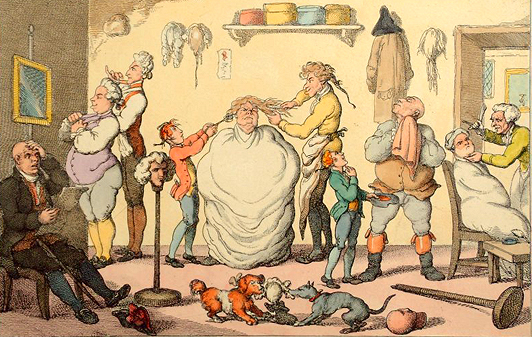
Eighteenth-century wig and barber shop.
One of the things that has made studying the eighteenth century (rather than contemporary literature, as was my original specialization when I first entered grad school) absolutely fascinating is all the amazing nuggets of historical information that I've dug up while doing research.

Many people don't know just how many things that we take for granted as modern inventions (like dildos or condoms) actually have long historical roots. The reverse is also true: there are many bizarre historical facts and beliefs that we have forgotten or, perhaps, chosen to forget, because they became outdated (like the practices of using mouse fur to make fake eyebrows or mercury to "cure" syphilis).

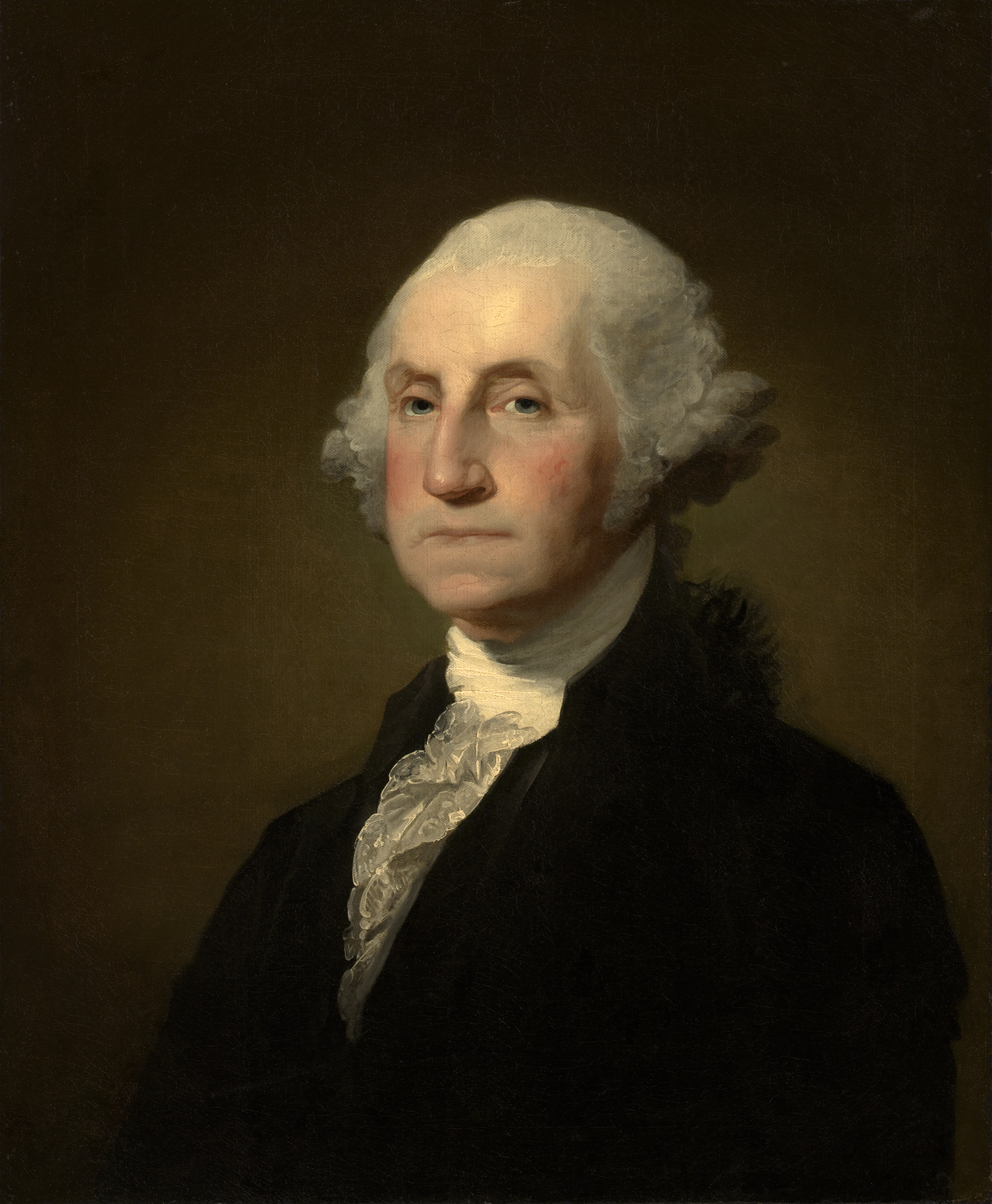
America's famously clean-shaven
founding father, George Washington.
While researching concepts of the gendered body in the eighteenth century, I ended up reading up quite a bit on beards, facial and otherwise. It took me some time to realize that although characters mention facial beards in eighteenth-century works (like Moll, in Defoe's  Moll Flanders), the beard itself was unfashionable in the eighteenth century. The more I looked, the more I came to realize that clean-shaved-ness was expected of men for nearly the whole century. Portraits of all the King Georges, the American "Founding Fathers" and many other noted luminaries of the time portray men always clean shaven, though they do, occasionally, include a five o'clock shadow.

Some forms of facial hair, like the mustache, were almost always popular among military men, but overall, even in the military, men were expected to have a razor and keep up with shaving--or to make time to go to a barber. While the beard, as described by historian Will Fisher, was hugely popular in the Renaissance, to the point that it was a defining characteristic of mature masculinity, and mustaches and mutton chops are the calling cards of the Victorian period, the eighteenth century was almost completely facial-hair free.

The ability to grow a facial beard, however, was significant in the eighteenth-century European cultural imaginary, as it came to be thought of as an essential aspect of the white man's supremacy over other races. Eighteenth-century naturalists like Francois Bernier and Richard Bradely used the relative beardedness of different peoples to identify and classify different races. The beard-growing Europeans were "naturally" superior to the beardless Asians and native peoples of the Americas, and their practice of shaving made them superior to the "unkempt" bearded men of the African continent.

In Peter the Great's Russia, Peter himself imposed a "beard tax" on upper-class men who did not shave in hopes of moving Russia further toward the "civilized" West, further associating shaving with being evolved and Enlightened. (Though it is worth noting that both Henry VIII and Elizabeth I also levied beard taxes in England in earlier periods.)

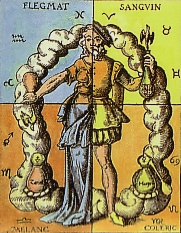
Medieval illustration
of the 4 humors.
Of course, the inability to grow facial hair was also thought of as yet another sign of why women were inferior to men. According to Linnaeus, who came up with this theory based on the theory of the humors, men were "dry and hot," and the excess heat in the body manifested in either sperm or hair. Facial hair was therefore caused by the heat of reabsorbed semen in the male body. Interestingly, bearded women were therefore quite threatening in this hierarchy, as they sported hair that was supposed to belong to the male sex exclusively.

Similarly, women who were independent, powerful, intelligent or self-sufficient were also often thought of as "bearded." Immanuel Kant, for example, invoked the beard in his attach on learned women like the classicist Madame Dacier or the physicist Emilie du Chatelet, citing that women like them "might just as well havea  beard, for that expresses in a more recognizable form the profundity for which she strives." Actual bearded women, however, were dismissed as unfeminine, while the whiskers of postmenopausal women were explained through the Galenic model of reabsorbed bodily fluid--the fluids no longer expelled through menstruation reformed into facial hair.

Also of note, in eighteenth-century narratives of cross-dressing women, many women who tried to pass as men, like the female soldier Hannah Snell, had to figure out how to distract others from their lack of facial hair. Several of them compensated for this lack by soliciting the desires of other women, thus appropriating yet another kind of "beard."

Thursday, November 21, 2013

Ladies in Breeches: Hannah Snell


My primary research interest in the eighteenth century right now is the representation of cross-dressed women in the literature . One of my favorite characters is that of Hannah Snell, a real life female cross-dresser, whose story was written and published under the title, The Female Soldier, in 1747 in England.

One of the most popular images of Snell.


Hannah sailed the seas with the British marines, disguised as a man, and, according to her story (she was illiterate, so her story is told by a, seemingly male, narrator), her female sex was never discovered. Initially, she joins the army in order to find her husband, who abandoned her when she was pregnant. After she gives birth and her child dies, she decides to find him. She hears of his being pressed into service (this was common in the 18th century as Britain waged many wars and conquests without the resource of a standing army; more about that when I discuss Peg Woffington and her turn as “The Female Volunteer” next week!) and decides to join up herself in search of him.

While on her travels, she sees the world, and eventually she fights at the Battle of Pondicherry, India, where she is wounded with a groin wound. She manages to escape being “discovered” by convincing a local woman (referred to in the text as a “Black,” though this designation applies to the Indians of India in the eighteenth-century) to give her some ointment for her wound.

As with many of the “passing women” of the eighteenth century, Hannah must prove herself with feats of strength—and flirtations with other women. She defends the honor of several women in port who may have otherwise fallen in with some of her fellow crewmen with evil intentions, and these women apparently find her version of masculinity quite appealing. 

A rather different image of Snell.
 
Upon her return, Hannah goes with her ship’s mates to the marine offices to prove that she indeed served aboard ship and to collect her pay—which she does, successfully. Afterwards, she appears in her uniform on stage at Sadler’s Wells, performing her military exercises for money.

While the text ends on a happy note, historians have found evidence that Snell eventually re-married (rather unhappily) and died alone and in poverty (not unusual for an interesting, independent woman of this period, unfortunately; the writer Aphra Behn also died in pain and in poverty despite penning many fantastic works of fiction, poetry and plays).

What I find fascinating about the actual text of Snell’s tale are the narrative contortions necessary to make Snell a virtuous woman but also a strong and valiant character. She’s good at disguising herself (lying to others), but it’s ok, because she’s doing it for a noble end. She’s deathly afraid of getting raped aboard ship, but she’s also one of the toughest and strongest crew members. Most interestingly for my research is the narrator’s insistence that we understand exactly how she passed despite being female-bodied. We never learn how she relieved herself aboard ship in front of fellow crew-members, or how she hid her monthly menses, but we get a blow by blow of how she dug out the bullet from her own groin at Pondicherry to avoid dealing with a surgeon. 
 
A less masculine version of Snell.
Similarly, when Snell is to be whipped shirtless in front of the company for disobeying orders, the narrator goes into detail about how she had small breasts, and how she wore a bandanna, and how she stood with her arms held up and facing the wall, so no one could tell she had breasts. Snell’s female-bodied-ness is central to the story, as it establishes the need to stay hidden, it illustrates how much she wishes to preserve her virtue, and it creates the central tension of the text. On the other hand, this need to keep her true sex hidden leads her to flirt with other women, women who, according to the text, seem to really, really like her. As a man. Or something. The ambiguity, the possibility of reading women like Snell from many different angles, is part of what makes the study of 18th-century female cross-dressers so fascinating.