Having
recently re-read Jane Austen’s Mansfield
Park (1814), I was struck towards the end by the parallels between that
novel, and Elizabeth Inchbald’s 1791 novel A
Simple Story. Outwardly, it may seem that the novels have very little in
common. Austen’s novel tells the story of Fanny Price, a gentle, timid soul,
sent to live with her well-to-do relations, yet never treated as quite equal to
them. She falls in love with her cousin Edmund, and the novel’s central
conflict arises when Edmund falls in love with Miss Mary Crawford, whose
brother, Henry Crawford, after flirting egregiously with Edmund’s two sisters,
Maria and Julia, finally decides to court Fanny.
Having
recently re-read Jane Austen’s Mansfield
Park (1814), I was struck towards the end by the parallels between that
novel, and Elizabeth Inchbald’s 1791 novel A
Simple Story. Outwardly, it may seem that the novels have very little in
common. Austen’s novel tells the story of Fanny Price, a gentle, timid soul,
sent to live with her well-to-do relations, yet never treated as quite equal to
them. She falls in love with her cousin Edmund, and the novel’s central
conflict arises when Edmund falls in love with Miss Mary Crawford, whose
brother, Henry Crawford, after flirting egregiously with Edmund’s two sisters,
Maria and Julia, finally decides to court Fanny.
By contrast, A Simple Story tells the somewhat tragic tale of Miss Milner, a
headstrong young woman who ends up marrying her guardian, cheating on him while
he is out of the country, and being banished to a dank cottage with their
little daughter Matilda. The final volume of the novel reunites Matilda with
her father, but not before we as readers see the full extent of Lord Elmwood’s
tyranny and selfishness and the terrible, terrifying sense of dependence all
his friends and family feel around him. The final words of A Simple Story are a somewhat cryptic message about female
education:
“And Mr. Milner, Matilda’s grandfather,
had better have given his fortune to a distant branch of his family—as
Matilda’s father once meant to do—so he had bestowed upon his daughter A PROPER
EDUCATION.”
Little is explicitly mentioned in
Inchbald’s novel about female education, except that Miss Milner was sent to “a
Protestant boarding-school” and had received “merely such sentiments of
religion, as young ladies of fashion mostly imbibe. Her little heart employed
in all the endless pursuits of personal accomplishments, had left her mind
without one ornament.” Instead, it is her daughter who avoided the “pernicious
effects of an improper education” through her education in “the school of
prudence—though of adversity—in which [she] was bred.”
 |
| Many eighteenth-century novels consider the question of what kind of education is best for young ladies. |
Austen’s narrator in Mansfield Park echoes many of the same views at the end of that
novel. Sir Thomas, for example, reflects on the lack of a proper education for
his daughters Maria and Julia, the first of whom runs away with Henry Crawford
after marrying a rich buffoon Mr. Rushworth, and the second of whom elopes to
Gretna Green with a man the family barely knows. In considering his daughters,
Sir Thomas experiences “the anguish arising from the conviction of his own
errors in the education of his daughters [that] was never to be entirely done
away.”
Still, despite the “grievous
mismanagement” of Maria and Julia’s educations, “he gradually grew to feel that
it had not been the most direful mistake in his plan of education. Something
must have been wanting within, or
time would have worn away much of its ill effects…they had never been properly
taught to govern their inclinations and tempers by that sense of duty which can
alone suffice. They had been instructed theoretically in their religion, but
never required to bring it into daily practice…of the necessity of self-denial
and humility he feared they had never heard from any lips that could profit
them.”
 |
| More and more women learned to read and write over the course of the 17th and 18th centuries, allowing them to weigh in on philosophical questions regarding the self and society. |
The language of the two texts is
remarkably similar: both Inchbald and Austen are reflecting, through their
narrators and characters, on the notion that education must not only include
the general project of gaining knowledge of the outside world, but that it must
also encompass self-knowledge and self-management. One might have a dissipated
character or certain harmful tendencies, but both novels (and many other
eighteenth-century novels, including but not limited to the novels of Frances
Burney, Maria Edgeworth, & Frances Sheridan) seem to suggest that bad
habits must be corrected at an early age, that denial is a better teacher for
children than indulgence, and that once the damage is done, it is extremely
hard to undo.
In Mansfield
Park, Fanny seems to be the only character who sees the Crawfords for who
they really are. She is not blinded by desire like her cousins. Instead, she
judges Mary and Henry by her first impressions, and Mary is immediately tainted
by her pronouncements against the clergy (Edmund’s chosen vocation) and Henry
by his dangerous flirtations with Julia and Maria (the latter of whom is
already engaged to another man). At the end of the novel, the narrator suggests
that if Henry and Mary had managed to ally themselves with Fanny and Edmund,
respectively, they might have shed some of their bad habits. But by indulging
their follies and vices and allowing themselves to be more influenced by their
London friends and their whims and vanity, they cannot escape their own bad
characters.
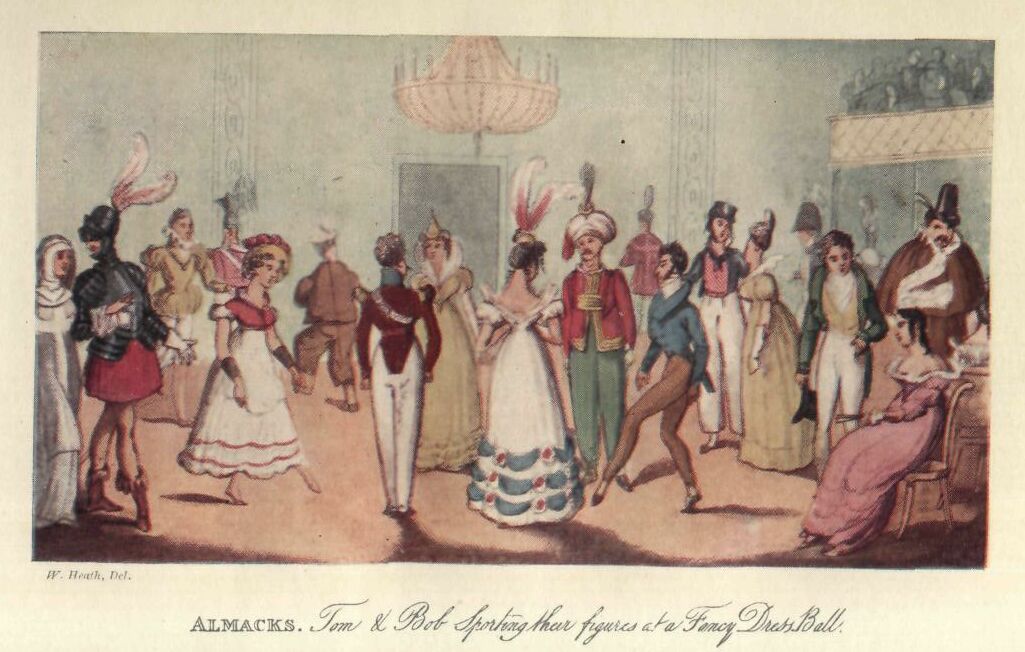 |
| Many novels suggest that indulging in too much of a "party lifestyle," which included masquerade balls, could throw one into "bad company", i.e. people whose lack of a moral compass could potentially "ruin" a young lady's reputation--or soul--forever. Were they alarmist--or essentially right? |
What strikes me the most when I read
Austen’s novels, and indeed many works by her contemporaries, are the ideas
about human character that are quite different from how we think of character
today. I’m generalizing somewhat here, but it seems to me that for many people
today, we consider that one’s character is not “fixed” throughout life.
Instead, we see character and personality as something that develops over time,
and most of us would shudder to think that we are the same person, at our core,
with the same attitude towards life, the same goals, the same needs, as five,
ten, or fifteen years ago. Yet, in eighteenth- and early nineteenth-century
novels, I get the sense that people very strongly believed that character was
fixed quite early on and very difficult to change.
While it may be true that certain
qualities of our personalities may indeed be fixed from a young age (for
example, whether one is more introverted or more extroverted), today’s ideology
of “self-improvement” suggest that we can keep improving our selves
interminably. Maybe this is a very American kind of attitude as well. And
though I would never encourage anyone to stop trying to better themselves, we
might learn just as much about ourselves—and our closest friends and family—if we
stop to consider those parts of us that are “fixed”—for better or for worse.