Showing posts with label Jane Austen. Show all posts

Thursday, April 20, 2017

Images from #ASECS17

My apologies to all my readers for my prolonged silence on the blog! I aim to repay you for your patience with more regular updates. To kick off my return to the blog, I bring you some images from the most recent meeting of the American Society for Eighteenth-Century Studies in Minneapolis, MN, March 30-April 1, 2017.
One of the things I enjoy the most about ASECS is learning about texts, events, and images that I previously did not know about. I’d like to share some of these images with you, dear readers, for your delight and edification.

1. “The Muff”, 1787 (London)
Kelly Fleming gave a wonderful talk on the first session on “Bodies as Objects,” on Thursday morning, March 30th. She discussed Sophia Western’s muff in Henry Fielding’s Tom Jones, and how the eighteenth-century muff did, in fact, have the connotation that you think it does. More interestingly, though, Fleming discussed how the muff “conflated the materiality of the female body with the materiality of female sexuality.”  Further, muff jokes in the novel often refer to legal issues of property transfer, according to Fleming, suggesting that a muff is never just an article of outerwear.


2. The panel I presented on, “Disability in Austen,” did not contain very many images—although there was a lot of great conversation and the inimitable Devoney Looser and her Mondrianesque outfit deserve to be immortalized in these pages. There was one image, however, presented by Emily Stanback, that deserves mention—it was an image of Jane Austen’s family tree. While the image below is not exactly the one that Stanback used (from the Jane Austen Centre in Bath), it represents the same issue that Stanback discussed in her paper on disability in Jane Austen’s family life. The family tree includes Austen’s brother George, though he is represented not with his own portrait, because, as Stanback discussed, there were no portraits taken of George during his life, probably because he was intellectually disabled. Some biographies do not even discuss George at all, but by putting George back on the family tree, such images acknowledge his humanity, and his probable impact on Austen and her “sympathetic capacities” as a writer.


3. Friday morning I made my way to a round table based on a collection of essays entitled “Women’s Periodicals and Print Culture.” Laura Engel discussed how actresses, princesses, and queens were often represented in miniatures printed in eighteenth-century magazines and the ways in which these images equated the lowly actress with her royal betters. The image of Susanna Highmore, painted by Joseph Highmore, depicts the lady holding a miniature next to a book that looks like a scrapbook or magazine. Engel theorized that perhaps such miniatures in magazines were cut out and preserved by readers as eighteenth-century “celebrity pinups.”


4. In the same session, Chloe Wigston Smith discussed the role of fashion in periodicals and specifically how fashion functioned “as tactile knowledge” in the eighteenth century. The Lady’s Magazine included fashionable patterns for lace and embroidery, giving women access to fashionable patterns that they could adapt and mimic as they wished. For more on the Lady’s Magazine Project, go here.


5. Later in the day on Friday, I attended the Gay and Lesbian caucus (of which I am the co-chair with the ever dapper and dashing Declan Gilmore-Kavanagh—check out his new book Effeminate Years!) session on “Queer Animals.” Jeremy Chow presented on monkeys in the eighteenth century and referenced the image of John Wilmot, 2nd Earl of Rochester, with a monkey. The monkey, Chow explained, was connected to ideas of sexual excess, lechery, and lasciviousness in the Restoration and eighteenth century. In Rochester’s portrait, the monkey, appearing as it does below a laurel wreath dangled by Rochester, may in fact symbolize and satirize the feud between Rochester and the then-poet laureate, John Dryden.


Sunday, June 19, 2016

The Art of Self-Knowledge in Austen

Having recently re-read Jane Austen’s Mansfield Park (1814), I was struck towards the end by the parallels between that novel, and Elizabeth Inchbald’s 1791 novel A Simple Story. Outwardly, it may seem that the novels have very little in common. Austen’s novel tells the story of Fanny Price, a gentle, timid soul, sent to live with her well-to-do relations, yet never treated as quite equal to them. She falls in love with her cousin Edmund, and the novel’s central conflict arises when Edmund falls in love with Miss Mary Crawford, whose brother, Henry Crawford, after flirting egregiously with Edmund’s two sisters, Maria and Julia, finally decides to court Fanny.
By contrast, A Simple Story tells the somewhat tragic tale of Miss Milner, a headstrong young woman who ends up marrying her guardian, cheating on him while he is out of the country, and being banished to a dank cottage with their little daughter Matilda. The final volume of the novel reunites Matilda with her father, but not before we as readers see the full extent of Lord Elmwood’s tyranny and selfishness and the terrible, terrifying sense of dependence all his friends and family feel around him. The final words of A Simple Story are a somewhat cryptic message about female education:
“And Mr. Milner, Matilda’s grandfather, had better have given his fortune to a distant branch of his family—as Matilda’s father once meant to do—so he had bestowed upon his daughter A PROPER EDUCATION.”
Little is explicitly mentioned in Inchbald’s novel about female education, except that Miss Milner was sent to “a Protestant boarding-school” and had received “merely such sentiments of religion, as young ladies of fashion mostly imbibe. Her little heart employed in all the endless pursuits of personal accomplishments, had left her mind without one ornament.” Instead, it is her daughter who avoided the “pernicious effects of an improper education” through her education in “the school of prudence—though of adversity—in which [she] was bred.”

Many eighteenth-century novels consider the question
of what kind of education is best for young ladies.
Austen’s narrator in Mansfield Park echoes many of the same views at the end of that novel. Sir Thomas, for example, reflects on the lack of a proper education for his daughters Maria and Julia, the first of whom runs away with Henry Crawford after marrying a rich buffoon Mr. Rushworth, and the second of whom elopes to Gretna Green with a man the family barely knows. In considering his daughters, Sir Thomas experiences “the anguish arising from the conviction of his own errors in the education of his daughters [that] was never to be entirely done away.”
Still, despite the “grievous mismanagement” of Maria and Julia’s educations, “he gradually grew to feel that it had not been the most direful mistake in his plan of education. Something must have been wanting within, or time would have worn away much of its ill effects…they had never been properly taught to govern their inclinations and tempers by that sense of duty which can alone suffice. They had been instructed theoretically in their religion, but never required to bring it into daily practice…of the necessity of self-denial and humility he feared they had never heard from any lips that could profit them.”
More and more women learned to read
and write over the course of the 17th and 18th
centuries, allowing them to weigh in
on  philosophical questions regarding
the self and society.
The language of the two texts is remarkably similar: both Inchbald and Austen are reflecting, through their narrators and characters, on the notion that education must not only include the general project of gaining knowledge of the outside world, but that it must also encompass self-knowledge and self-management. One might have a dissipated character or certain harmful tendencies, but both novels (and many other eighteenth-century novels, including but not limited to the novels of Frances Burney, Maria Edgeworth, & Frances Sheridan) seem to suggest that bad habits must be corrected at an early age, that denial is a better teacher for children than indulgence, and that once the damage is done, it is extremely hard to undo.
In Mansfield Park, Fanny seems to be the only character who sees the Crawfords for who they really are. She is not blinded by desire like her cousins. Instead, she judges Mary and Henry by her first impressions, and Mary is immediately tainted by her pronouncements against the clergy (Edmund’s chosen vocation) and Henry by his dangerous flirtations with Julia and Maria (the latter of whom is already engaged to another man). At the end of the novel, the narrator suggests that if Henry and Mary had managed to ally themselves with Fanny and Edmund, respectively, they might have shed some of their bad habits. But by indulging their follies and vices and allowing themselves to be more influenced by their London friends and their whims and vanity, they cannot escape their own bad characters.
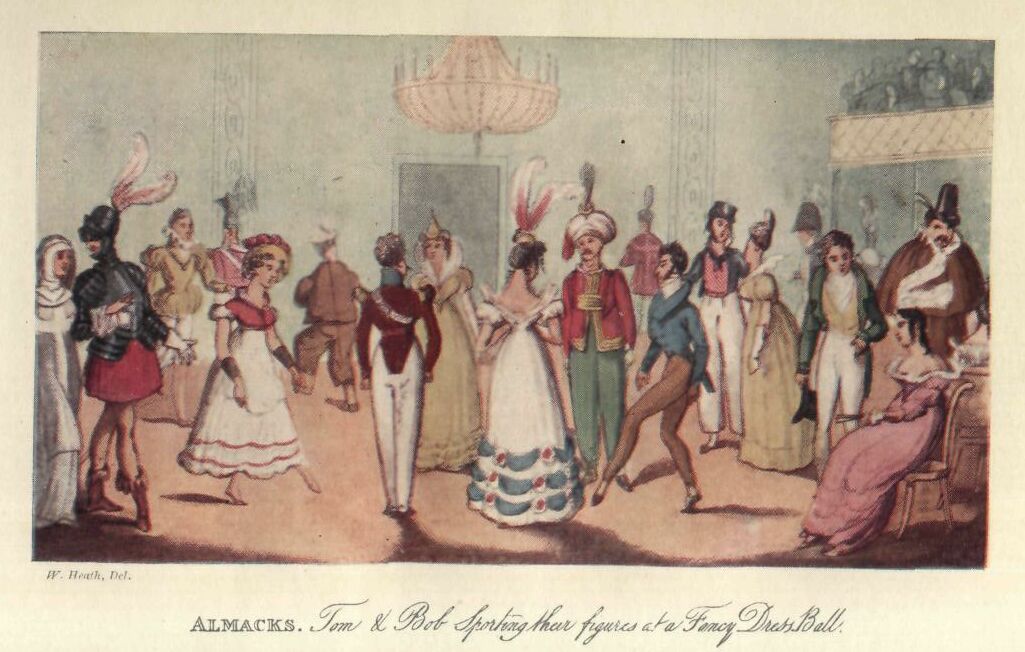
Many novels suggest that indulging in too much of a "party lifestyle," which included masquerade balls,
could throw one into "bad company", i.e. people whose lack of a moral compass could potentially
"ruin" a young lady's reputation--or soul--forever. Were they alarmist--or essentially right?

What strikes me the most when I read Austen’s novels, and indeed many works by her contemporaries, are the ideas about human character that are quite different from how we think of character today. I’m generalizing somewhat here, but it seems to me that for many people today, we consider that one’s character is not “fixed” throughout life. Instead, we see character and personality as something that develops over time, and most of us would shudder to think that we are the same person, at our core, with the same attitude towards life, the same goals, the same needs, as five, ten, or fifteen years ago. Yet, in eighteenth- and early nineteenth-century novels, I get the sense that people very strongly believed that character was fixed quite early on and very difficult to change.

While it may be true that certain qualities of our personalities may indeed be fixed from a young age (for example, whether one is more introverted or more extroverted), today’s ideology of “self-improvement” suggest that we can keep improving our selves interminably. Maybe this is a very American kind of attitude as well. And though I would never encourage anyone to stop trying to better themselves, we might learn just as much about ourselves—and our closest friends and family—if we stop to consider those parts of us that are “fixed”—for better or for worse. 

Saturday, May 28, 2016

Clueless Heroines: Jane Austen’s Emma in the Classroom

This past spring semester I taught Austen’s Emma in an upper-level survey course on Restoration and eighteenth-century literature. I realize I’m pushing the boundaries of the time period somewhat by teaching Austen’s 1816 novel, which is currently celebrating its bicentennial. Still, Austen is a transitional figure, and it felt like a nice juxtaposition against the other works of fiction that we read, which included Aphra Behn’s The Fair Jilt and Daniel Defoe’s Roxana. All three of these works contain heroines which my students had a hard time liking.
In the case of Behn’s Miranda and Defoe’s Roxana, it is easy to see how these fictional characters might elicit disgust or dislike from their readers. Miranda is a caricature of feminine evil, falsely accusing a priest of raping her when he spurns her advances, and then plotting to kill her sister, seducing first a servant and then her own husband to commit the murder (first by poison and next by gunfire). Roxana is hardly better: initially she must give up her virtue to save herself and her children from starvation, but she admits later in the novel that even when she could finally retire from being a kept woman, her own vanity and greed compel her to seek even greater fame and riches. By the end of the novel, when her own daughter finds out her identity, Roxana not only refuses to acknowledge her, but instead wishes her dead.
Austen’s Emma, by contrast, seems quite saintly. She’s “handsome, clever, and rich,” as the famous first line declares, and her worst quality is “the power of having rather too much her own way, and a disposition to think a little too well of herself.” And yet, my students decidedly did not like her—especially in the first half of the novel. In writing assignments, some of them denounced Emma as manipulative and controlling, deeming her interest in Harriet Smith “obsessive.”
The frontispiece to Emma.

When it comes to the most well-known heroes and heroines of fiction, readers are often split into the “love them” or “hate them” camps. Ask any avid reader what they think of characters like Samuel Richardson’s Pamela, Jane Austen’s Eliza Bennet, Charlotte Bronte’s Jane Eyre, or George Eliot’s Dorothea Brooke, and you are likely to get  strongly-worded answer. And of course, this doesn’t just hold to female character, either. Most readers have similarly strong opinions about Shakespeare’s Hamlet, Defoe’s Robinson Crusoe, Dickens’s David Copperfield, or even JK Rowling’s Harry Potter.
Of course, it’s quite possible, and rather normal, to dislike a character and still enjoy a novel about that character. (Though I would argue that it’s difficult to like a novel in which one  dislikes all the characters—but not impossible.) One’s attitude towards a character and that character’s good or bad qualities also wanes with time. I chuckled a little when several of my students expressed their rabid dislike of Emma because I could remember reader Emma in college and disliking her myself. She was too full of herself, too silly, too meddling, despite having all the advantages a lady of Austen’s time could want.
On rereading Emma, I found I minded Emma’s follies less. Instead, I was more struck by how little happens in the novel. Much of it occurs inside character’s heads—it is taken up with feelings, letters, decisions, and a lot of waiting. What does not fall into the camp of thought and reflection is taken up with dialogue—often great lengths of it, spoken by characters with less than stellar qualities, like the ever-babbling Miss Bates, the rather vulgar Mrs. Elton, and, at times, the ever-lecturing Mr. Knightley.
Part of the exhibit "Emma at 200" at Chawton House in England.
Mr. Knightley is not a bad character, all-in-all. Reading Emma at twenty-one, I disliked Mr. Knightley quite a bit. He seemed even more full of himself than Emma, always lecturing her and telling her she was wrong. It was insufferable.  And then to have Emma actually marry him at the end of the novel! It was altogether disagreeable, to put it in Austenian terms. This situation was probably what irked me the most as a young adult: the novel’s central assumption is that Emma is a silly girl who knows nothing of how the world works and must be taught a lesson through not one, not two, but three major humiliations: being wrong about Mr. Elton; being wrong about Frank Churchill & Jane Fairfax; and getting reprimanded by Mr. Knightley for her improper behavior towards Miss Bates.
Despite this year being the
200th anniversary,
Emma had quite the moment in
1995-6, with  Clueless, & 2
other adaptations, one
with  Gwyneth. Paltrow (above)
and one  with Kate Beckinsale.
While other Austenian heroines must learn to set aside their prejudices (like Eliza Bennet) or their fantasies (like Marianne Dashwood), neither of them are quite so chastened as Emma Woodhouse. Reading Emma at the same age as its heroine, I was annoyed and displeased by the assumption that Emma was quite so wrong about so many things. Reading the novel again and also teaching it this year made me reflect instead on the many layers of it, the way that Austen builds the relationships with the characters and gives us insight into their thoughts and psyches. Many claim that Samuel Richardson is one of the earliest English authors to truly bring the human psyche onto the page, but I feel quite comfortable giving those laurels to Jane Austen. Even a heroine as seemingly clueless as Emma can be of interest to readers when we are allowed to sit inside her thoughts for five hundred pages. (Pamela, as I have argued elsewhere, never seems more than a caricature of female cluelessness.)
And speaking of cluelessness, of course I had my class watch Clueless (dir. Amy Heckerling, 1995) as a follow-up to the novel. This was my first time watching the film directly after reading the book, and I had to admire yet again the filmmakers for their skill and creativity at adapting Austen’s novel in such a fun, and yet strangely faithful way. In many ways, Cher Horowitz is very different, of course, than Emma. She is more fashion-oriented and interested in “retail therapy,” and her “clueless” disposition as a Beverly Hills teenager means she is “ditzy” in a way that I wouldn’t necessarily connect to Austen’s Emma.
Cher and her besties, Dionne (left, played by Staci Dash), and
Tai (right, played by Brittany Murphy) in the role of Harriet Smith.
I can see, however, why the filmmakers developed Cher’s character in this way: Cher’s “ditz with a credit card” status immediately establishes her as recognizable archetype for viewers who haven’t read the book. In this way, Heckerling’s film places us, the viewers, into the role not only of the reader of the novel, who judges the heroine, but also of the other inhabitants of Highbury, who, knowing little of Emma/Cher, judge her by her looks, her money, and her status. Cher is more or less about as likeable as Emma: as film viewers we appreciate her silliness, but are also privy to her whininess and petulance, as well as to her generosity and moments of genuine confusion.
How important is it to like characters in novels? When we teach novels that focus so centrally on characters and character development, it’s hard to divorce discussion of literary forms, themes, and plot from book club-type discussions of why or why not a certain novel or character appeals to us. After all, the point of “The Rape of the Lock” or “The Love Song of J. Alfred Prufrock” is not whether we like Pope’s Belinda and the Baron or Eliot’s Prufrock; such a discussion wouldn’t make any sense. Yet, when we discuss character like Emma, it’s difficult not to discuss whether we like or dislike the character. In the classroom, my best bet is to then turn the discussion around, and ask my students why Austen would create a character who is difficult to like, someone so imperfect, vain, or blinded.
Then, of course, there is the question of how to teach texts that we, as instructors, don’t much like, but that is a story for another post.


Tuesday, December 16, 2014

Jane Awesome

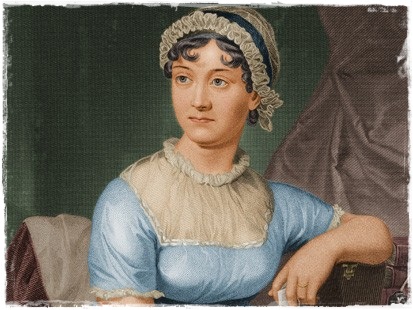
Today, December 16th, is Jane Austen’s birthday. Happy Birthday, Jane!


Despite Austen’s popularity today in the form of multiple BBC miniseries, Hollywood films, Pride & Prejudice­-themed board games, Jane Austen novel continuations, and a plethora of other Jane Austen awesomeness (like the Jane Austen action figure or Jane Austen toothpaste—spoiler, it’s rose-flavored!), many people have a prejudice against the scribe of Bath.

For many, Austen is little more than romance—it’s frothy, lacy, ephemeral and, ultimately, shallow. Charlotte Bronte maligned Pride and Prejudice, writing in a letter that it was “a carefully fenced highly cultivated garden, with neat borders and delicate flowers—but no glance of a bright vivid physiognomy—no open country—no fresh air—no blue hill—no bonny beck. I should hardly like to live with her ladies and gentlemen in their elegant but confined houses.”

Towards the end of the nineteenth century, Jane Austen’s works became increasingly popular and the term “Janeite” was coined to describe people who adored Austen’s works and everything about them. It may very well be that the zeal with which some adore Austen is precisely what makes others hate her. Modern-day Janeites exist now too, and it’s probably quite easy to make fun of them, as they dress-up in Regency clothing, learn how to dance eighteenth-century country dances, and even travel to England for a “JaneAusten Weekend.”

The idolatry and fandom surrounding Austen can often overshadow her literary achievements; the zeal of some fans seems to put her work in the same category as Star Trek and Harry Potter—things to nerd-out over, but not take seriously.

Of course, I disagree! Austen’s novels are well-crafted, well-written works that comment on a variety of topics, both singular to the eighteenth and early nineteenth centuries, as well as ones more universal and transcendent. In her works, she addresses both “domestic” issues, such as marriage, rules of civility, gender relations, family relations, entertainment, and the running of a household, as well as “worldly” issues, such as commerce, law, economics, nation-building, war, slavery, national character, landscape gardening, architecture, and aesthetics.

This is not to suggest that we can only designate literature as “Important” or “influential” because it addresses this second category of issues or theme. Instead, what I wish to point out is that there is no “domestic” without the “worldly”—and vice versa. Literature by women has, throughout history, been maligned, under-appreciated, discarded, forgotten, or otherwise neglected often because it deals with domestic issues. The same could be said of art or crafts or musical compositions by women. Alice Walker, among many women writers, has addressed this problem in her landmark essay “In Search of Our Mother’s Gardens.”

Similarly, when we study history in high school, it is often a history comprised of wars, battles, elections, economics, and individual “important men.” For some reason, what people ate, how many children they had, how they lived, what jobs they had, how they loved, married and died is not considered history worth teaching and writing. This concept is slowly changing in the academy—but popular conceptions of what count as important histories or significant works of literature still focus on a male-centered story arc.

To get back to Jane Austen, it seems that her novels and her contributions to literature are often under-valued not just because she was a woman, but also because her fans are overwhelmingly women. And because her main characters are women. And because the surface plot line is often “will the girl get the guy?”  (Never mind that the same could be said of countless novels by men!)

Yet, to discard Austen’s works, to read them merely for plot, to suggest that plot is what makes a work great or not, is to miss the entire point of literary study. The best literary scholars are those who are the most open to new views, to new works, to possibilities, ambiguities, silences, and apertures in the works we study. This message is itself part of Austen’s novels, and the crux of her most well-known work, Pride and Prejudice. To be too proud to read Austen’s novel, or too proud to admit to liking it, or, what’s worse, perhaps, to be so prejudiced about a work that you refuse to even read it, is juvenile and shallow: the very opposite of Austen’s work.
 
It's not all about marriage...and even if it is,
well, why does that make her novels less important?
I’ve tried to write this post as logically and rationally as possible, but the truth is, I’m a total Janeite. My roller derby name is Jane AweStun. I would totally go to a Jane Austen Weekend if I could afford it. So, rock on, Jane! Happy Birthday, you badass.


…and to my fellow Janeites: be strong! Haters gonna hate…but it is a truth universally acknowledged that geeking out is a lot more fun than joining the haters…