Showing posts with label marriage. Show all posts

Monday, February 29, 2016

The Lady's Prerogative

Happy Leap Day!

Leap day has been on February 29th since the adoption of the Gregorian
Uh oh, the ladies are up to something...
 calendar in 1582. The concept of a “leap day” was incorporated into the much earlier Julian calendar, however, in which February normally had 23 days and on leap years it had 24.


Apparently, among the superstitions and traditions associated with leap day is that on this day, it was acceptable historically for a woman to propose marriage to a man. As early as 1600, in an anonymously-published play, The Maid’s Metamorphosis, we see the tradition of gender reversal on leap day referred to in the following lines: “Maister be comforted, this is leape year/ Women wear breeches, petticoats are deare.”

Did she really get down on her
knees and beg St. Patrick for a day
"for the ladies"???
Many sites on the web claim that the “tradition” is linked to Irish folklore and stories of St. Brigid begging St. Patrick for a special day for the women to propose, or Queen Margaret enacting a law in 1288 to allow women to propose to men. Both stories have been debunked due to issues of time (for example, St. Brigid would have been 9 when St. Patrick died), but they are both firmly rooted in Irish Catholic tradition. (As is the contemporary film that portrays this tradition, Leap Year.) Other sources cite leap day as being the feast of St. Oswald, a Saxon saint. Part of his feast day tradition was, in Elizabeth times, to allow the ladies to propose to long-time suitors.


In part, this tradition is thought to relate to the fact that leap day had “no standing” in English law or, in other words, that day had “no legal status” and was “leaped over” and ignored by legal bodies—hence “leap year.” If the day had no legal status, then one could presumably overstep the usual social boundaries without the usual repercussions; therefore, women could propose to men rather than having to wait on the gentleman. (If anyone can clarify what it means, legally, that a day can have no legal status, I would be grateful. I found the reference to this in Shakespeare's Festival Worlds, by Frangois Laroque, pg. 107.)

Some traditions state that a man who refuses a woman’s proposal on this day will face bad luck or that he must pay her back in gloves (presumably to hide her ringless hand). Other traditions state that a woman who wishes to propose on this day must wear breeches as she does so. Later, this was changed to a red petticoat that had to be visible when she approached her wary victim.

I have yet to find any real, hard evidence for these supposed traditions, by which I mean texts from the past that mention them, except the reference to The Maid’s Metamorphosis. If anyone has any leads, please let me know—especially if they relate to Leap Day traditions from the long eighteenth century!
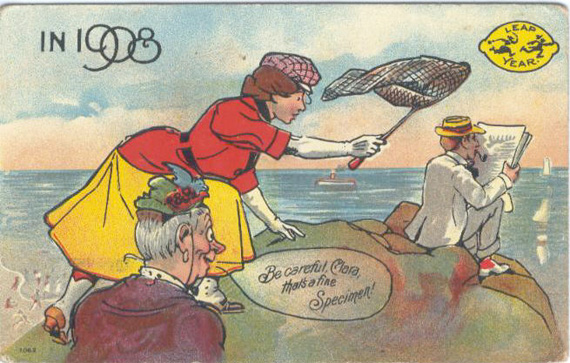
 
A husband-hunter spots her quarry in a 1908 postcard.
As a researcher interested in female cross-dressing, this sounds like a particularly juicy story to add to my compendium of examples. As a feminist, though, I have to wonder about the “tradition” of men proposing to women throughout history, which inevitably lead to designating one day every four years in which women could propose to men. (Too much more often than that, and things could get out of hand…)

It is well-known and documented that in the Middle Ages and Elizabethan era, sex before marriage was common and accepted. (For more on the history of sexuality in Europe and premarital sexual practices, check out books by Tim Hitchcock & Karen Harvey.) It seems hard to believe that in all cases, women waited for men to broach the subject. Undoubtedly, there were cases in which couples came together to the decision to marry, and in many cases, the man did not do the proposing at all--proposals were completely handled by the parents. On both sides.
 
She's no catch...but she's caught her man.
Marital traditions that we document the most clearly are often the traditions of the upper-classes and aristocracy, and many traditions that we think of as being around forever are actually quite new. Diamond engagement rings did not become mainstream until a DeBeers ad campaign in the early twentieth century, and white wedding dresses did not become popular until Queen Victoria’s wedding. Nowadays we would never consider wearing our wedding dress after the wedding day, but in The Age of Innocence by Edith Wharton (1920), we read that May wears her wedding dress out to various social events during the first year of her marriage.
 
Poor guy....tricked into marriage on Leap Day...

So, until I see some hard evidence about leap year marriage proposals in the form of pre-twentieth-century documents, I’m just a tad skeptical. It’s been an interesting tradition to read about, but for now, I think it might be more urban legend than actual tradition. When we take into account the many cartoons depicting ugly, creepy old women preying on unsuspecting young men, it’s hard not to think of this “tradition” as yet another way to discourage women historically from taking power into their own hands.

Wednesday, January 14, 2015

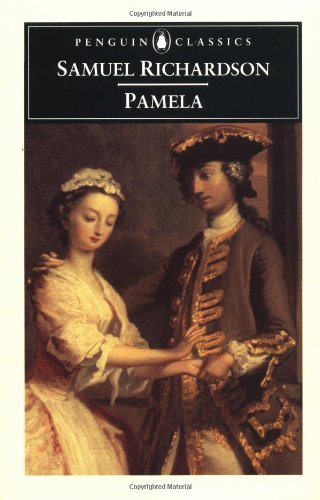
The Cinderella Complex: On the lasting effects of Pamela

It is a truth universally acknowledged that the second half of Pamela is not nearly as interesting as the first half. The first half of the novel details Pamela and Mr. B’s strange S&M-type relationship which includes multiple attempted rapes, kidnapping, beatings and verbal abuse of Pamela at the hands of her future husband.

The second half of the novel draws out their engagement, secret wedding, meeting the neighbors and finally reconciliation with Mr. B’s sister, Lady Davers. Lady Davers takes a lot of convincing, as she herself is of the conviction that by marrying Pamela, his mother's waiting-maid, Mr. B has debased himself. As they argue, Lady Davers tries to show her brother the error of his ways by suggesting that his marriage is the same as if she had married her groom.

“[Lady Davers:] Where can the Difference be between a Beggar’s Son marry’d by a Lady; or a Beggar’s Daughter made a Gentleman’s Wife?

Then I’ll tell you, reply’d he [Mr. B]; The Difference is, a Man ennobles the Woman he takes, be she who she will; and adopts her into his own Rank, but it what it will: But a Woman, tho’ ever so nobly born, debases herself by a mean Marriage, and descends from her own Rank, to his she stoops to.”

Mr. B’s answer perfectly sums up a sentiment shared by many people in the Western world from the eighteenth century onward. Even now, one might argue, there are those who would agree with his statement.

Such a statement might have made sense in the eighteenth century, as legally, a woman became her husband’s property upon marriage back then. In England, she automatically lost her maiden name upon marriage, as well. For many decades, anything a woman earned was considered her husband’s or her father’s property, and her wages could be garnished by the man of the house and spent by him as he wished.

Thus, an eighteenth-century author like Samuel Richardson truly would believe that it was the man’s rank that determined his wife’s—never vice versa.

It’s much harder, I think, to understand why so many people still believe in this idea today. Women have joined the work force, we have entered into some of the highest spheres in the workplace, and we have made many strides towards equality. 

At the same time men are still the primary breadwinner in most families around the world—and even in the Western world. Many men still have a hard time squaring the idea that they might stay at home while their wives go to work—even as the numbers of “stay at home dads” increase. Similarly, the lack of childcare options in the US, coupled with the shortest amount of paid maternity leave in the Western world mean that it still makes more “financial sense” for women to stay home with the children while their husbands go to work. (Of course, the lack of any kind of paternity leave for fathers only exacerbates these trends.)
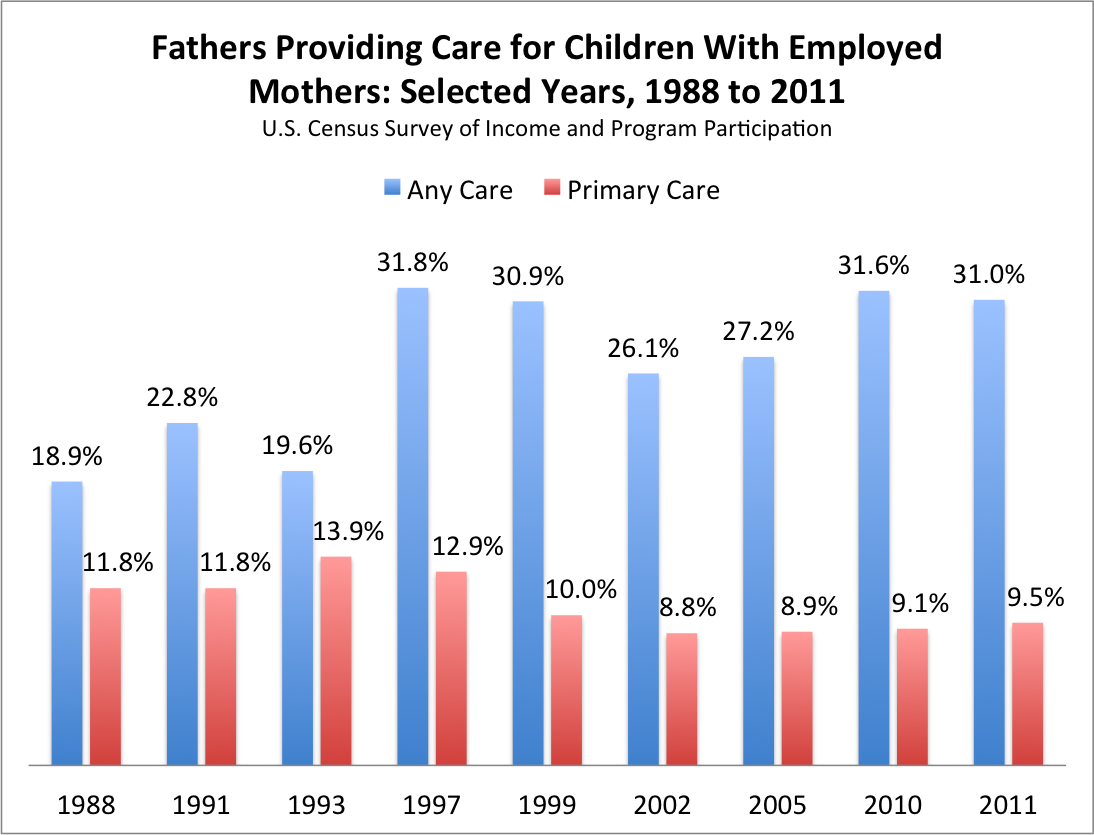
Even in 2011, only 9.5% of fathers are the primary care-givers for children.
That's nowhere near 50%...
On the other hand, to go back to the eighteenth century, there were many men and women who deplored the subordinate condition of women and who spoke out against it. Mary Astell, Anne Finch, the women of the Bluestocking group, Jeremy Bentham, and Mary Wollstonecraft are just some of the many writers, both male and female, who railed against the oppression and unequal treatment of women.

Were there any upper-class women who married far below them, in the manner of Mr. B and Pamela? Were there any writers who challenged Richardson’s implicit sense of righteousness that only a man could “ennoble” his wife—never vice versa? If my readers know of any, I’d be excited to hear about it.

Class is a slippery topic, more ephemeral, in some ways, than either gender or race. How do we identify class? Titles, money, family name, income vs. inheritance, position, tastes, and background all play a part. It is possible to be of a high class but to be poor (consider the impoverished nobility of the eighteenth and nineteenth centuries). It is possible to have wealth but retain lower-class tastes that taint one in the eyes of the upper classes (such as those who are deemed the nouveau-riche).

Pamela is considered so revolutionary precisely because it illustrates the changing categories of class in the eighteenth century. Pamela is allowed to be ennobled because she is so virtuous—but also, because she is so beautiful. In the novel, beauty and virtue are joined together, just as Mrs. Jewkes must be ugly because she has such low, evil tastes. Later female authors, like Frances Burney and Jane Austen, explicitly challenge the notion that beauty and virtue are always joined.

We can't get enough of Jane & Rochester!
Of course, it’s impossible to discount the far-reaching effects Pamela has on English literature. It’s hard to read Pamela without also immediately thinking about Jane Eyre, for example, and how Charlotte Bronte changes the ending so that Jane and Rochester are more equal—by making Jane financially independent. Even Pride and Prejudice is, to an extent, a rewriting of Pamela, where Lizzy is rewarded with a rich husband, but not for being a servile, virtuous virgin—for being an independent-thinking, witty young woman.

The Cinderella-complex that persists in all of these texts—and that still persists, even now, in popular films, television series, and best-selling novels—is perhaps the more disturbing phenomenon. As a culture we continually insist on telling young women that they should wish, hope, dream of having their problems solved by marriage to a handsome, wealthy man rather than becoming wealthy and powerful themselves…probably because wealthy, powerful women are much harder to control.


We love the myth of Cinderella so much, we've got 2 more film versions coming out, just this year!

Tuesday, December 16, 2014

Jane Awesome

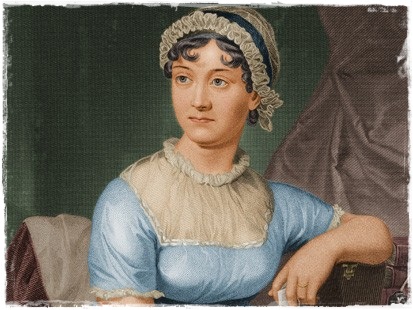
Today, December 16th, is Jane Austen’s birthday. Happy Birthday, Jane!


Despite Austen’s popularity today in the form of multiple BBC miniseries, Hollywood films, Pride & Prejudice­-themed board games, Jane Austen novel continuations, and a plethora of other Jane Austen awesomeness (like the Jane Austen action figure or Jane Austen toothpaste—spoiler, it’s rose-flavored!), many people have a prejudice against the scribe of Bath.

For many, Austen is little more than romance—it’s frothy, lacy, ephemeral and, ultimately, shallow. Charlotte Bronte maligned Pride and Prejudice, writing in a letter that it was “a carefully fenced highly cultivated garden, with neat borders and delicate flowers—but no glance of a bright vivid physiognomy—no open country—no fresh air—no blue hill—no bonny beck. I should hardly like to live with her ladies and gentlemen in their elegant but confined houses.”

Towards the end of the nineteenth century, Jane Austen’s works became increasingly popular and the term “Janeite” was coined to describe people who adored Austen’s works and everything about them. It may very well be that the zeal with which some adore Austen is precisely what makes others hate her. Modern-day Janeites exist now too, and it’s probably quite easy to make fun of them, as they dress-up in Regency clothing, learn how to dance eighteenth-century country dances, and even travel to England for a “JaneAusten Weekend.”

The idolatry and fandom surrounding Austen can often overshadow her literary achievements; the zeal of some fans seems to put her work in the same category as Star Trek and Harry Potter—things to nerd-out over, but not take seriously.

Of course, I disagree! Austen’s novels are well-crafted, well-written works that comment on a variety of topics, both singular to the eighteenth and early nineteenth centuries, as well as ones more universal and transcendent. In her works, she addresses both “domestic” issues, such as marriage, rules of civility, gender relations, family relations, entertainment, and the running of a household, as well as “worldly” issues, such as commerce, law, economics, nation-building, war, slavery, national character, landscape gardening, architecture, and aesthetics.

This is not to suggest that we can only designate literature as “Important” or “influential” because it addresses this second category of issues or theme. Instead, what I wish to point out is that there is no “domestic” without the “worldly”—and vice versa. Literature by women has, throughout history, been maligned, under-appreciated, discarded, forgotten, or otherwise neglected often because it deals with domestic issues. The same could be said of art or crafts or musical compositions by women. Alice Walker, among many women writers, has addressed this problem in her landmark essay “In Search of Our Mother’s Gardens.”

Similarly, when we study history in high school, it is often a history comprised of wars, battles, elections, economics, and individual “important men.” For some reason, what people ate, how many children they had, how they lived, what jobs they had, how they loved, married and died is not considered history worth teaching and writing. This concept is slowly changing in the academy—but popular conceptions of what count as important histories or significant works of literature still focus on a male-centered story arc.

To get back to Jane Austen, it seems that her novels and her contributions to literature are often under-valued not just because she was a woman, but also because her fans are overwhelmingly women. And because her main characters are women. And because the surface plot line is often “will the girl get the guy?”  (Never mind that the same could be said of countless novels by men!)

Yet, to discard Austen’s works, to read them merely for plot, to suggest that plot is what makes a work great or not, is to miss the entire point of literary study. The best literary scholars are those who are the most open to new views, to new works, to possibilities, ambiguities, silences, and apertures in the works we study. This message is itself part of Austen’s novels, and the crux of her most well-known work, Pride and Prejudice. To be too proud to read Austen’s novel, or too proud to admit to liking it, or, what’s worse, perhaps, to be so prejudiced about a work that you refuse to even read it, is juvenile and shallow: the very opposite of Austen’s work.
 
It's not all about marriage...and even if it is,
well, why does that make her novels less important?
I’ve tried to write this post as logically and rationally as possible, but the truth is, I’m a total Janeite. My roller derby name is Jane AweStun. I would totally go to a Jane Austen Weekend if I could afford it. So, rock on, Jane! Happy Birthday, you badass.


…and to my fellow Janeites: be strong! Haters gonna hate…but it is a truth universally acknowledged that geeking out is a lot more fun than joining the haters…