Today,
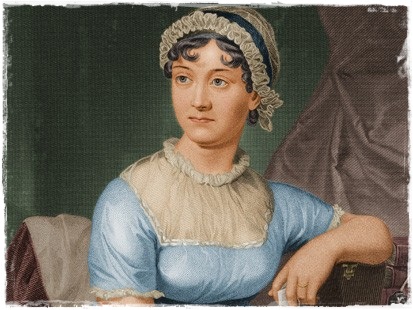
December 16th, is Jane Austen’s birthday. Happy Birthday, Jane!
Despite
Austen’s popularity today in the form of multiple BBC miniseries, Hollywood
films, Pride & Prejudice-themed
board games, Jane Austen novel continuations, and a plethora of other Jane
Austen awesomeness (like the Jane Austen action figure or Jane Austen
toothpaste—spoiler, it’s rose-flavored!), many people have a prejudice against
the scribe of Bath.
For
many, Austen is little more than romance—it’s frothy, lacy, ephemeral and,
ultimately, shallow. Charlotte Bronte maligned Pride and Prejudice, writing in a letter that it was “a carefully
fenced highly cultivated garden, with neat borders and delicate flowers—but no
glance of a bright vivid physiognomy—no open country—no fresh air—no blue
hill—no bonny beck. I should hardly like to live with her ladies and gentlemen
in their elegant but confined houses.”

Towards
the end of the nineteenth century, Jane Austen’s works became increasingly
popular and the term “Janeite” was coined to describe people who adored
Austen’s works and everything about them. It may very well be that the zeal
with which some adore Austen is precisely what makes others hate her.
Modern-day Janeites exist now too, and it’s probably quite easy to make fun of
them, as they dress-up in Regency clothing, learn how to dance
eighteenth-century country dances, and even travel to England for a “JaneAusten Weekend.”
The
idolatry and fandom surrounding Austen can often overshadow her literary
achievements; the zeal of some fans seems to put her work in the same category
as Star Trek and Harry Potter—things to nerd-out over, but not take seriously.
Of
course, I disagree! Austen’s novels are well-crafted, well-written works that
comment on a variety of topics, both singular to the eighteenth and early
nineteenth centuries, as well as ones more universal and transcendent. In her
works, she addresses both “domestic” issues, such as marriage, rules of
civility, gender relations, family relations, entertainment, and the running of
a household, as well as “worldly” issues, such as commerce, law, economics,
nation-building, war, slavery, national character, landscape gardening,
architecture, and aesthetics.
This
is not to suggest that we can only designate literature as “Important” or
“influential” because it addresses this second category of issues or theme.
Instead, what I wish to point out is that there is no “domestic” without the
“worldly”—and vice versa. Literature by women has, throughout history, been maligned,
under-appreciated, discarded, forgotten, or otherwise neglected often because
it deals with domestic issues. The same could be said of art or crafts or
musical compositions by women. Alice Walker, among many women writers, has
addressed this problem in her landmark essay “In Search of Our Mother’s
Gardens.”
Similarly,
when we study history in high school, it is often a history comprised of wars,
battles, elections, economics, and individual “important men.” For some reason,
what people ate, how many children they had, how they lived, what jobs they
had, how they loved, married and died is not considered history worth teaching
and writing. This concept is slowly changing in the academy—but popular
conceptions of what count as important histories or significant works of
literature still focus on a male-centered story arc.
To
get back to Jane Austen, it seems that her novels and her contributions to
literature are often under-valued not just because she was a woman, but also
because her fans are overwhelmingly women. And because her main characters are
women. And because the surface plot line is often “will the girl get the
guy?” (Never mind that the same could be
said of countless novels by men!)
Yet,
to discard Austen’s works, to read them merely for plot, to suggest that plot
is what makes a work great or not, is to miss the entire point of literary
study. The best literary scholars are those who are the most open to new views,
to new works, to possibilities, ambiguities, silences, and apertures in the
works we study. This message is itself part of Austen’s novels, and the crux of
her most well-known work, Pride and
Prejudice. To be too proud to read Austen’s novel, or too proud to admit to
liking it, or, what’s worse, perhaps, to be so prejudiced about a work that you
refuse to even read it, is juvenile and shallow: the very opposite of Austen’s
work.
 |
| It's not all about marriage...and even if it is, well, why does that make her novels less important? |
I’ve
tried to write this post as logically and rationally as possible, but the truth
is, I’m a total Janeite. My roller derby name is Jane AweStun. I would totally
go to a Jane Austen Weekend if I could afford it. So, rock on, Jane! Happy
Birthday, you badass.
…and
to my fellow Janeites: be strong! Haters gonna hate…but it is a truth
universally acknowledged that geeking out is a lot more fun than joining the
haters…