Black
Sails on the Horizon: Female Pirates Anne Bonny and Mary Read
From “The Life of Anne Bonny”, A General History of the Pyrates (1724)
“…she
became acquainted with Rackam the Pyrate, who making Courtship to her, soon
found Means of withdrawing her Affections from her Husband, so that she
consented to elope from him, and go to Sea with Rackam in Men’s Cloaths…”
“The
day that Rackam was executed, by special Favour, he was admitted to see her;
but all the Comfort she gave him, was, that
she was sorry to see him there, but if he had fought like a Man, he need not
have been hang’d like a Dog.”
 The
stories of Anne Bonny and Mary Read are fascinating and confusing, surprising
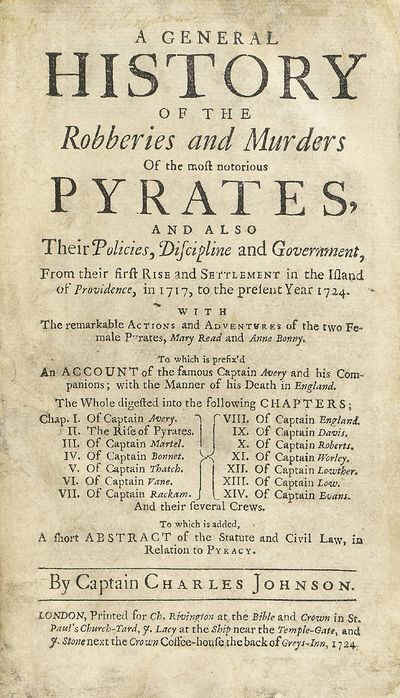
and entertaining. They were printed in A
General History of the Pyrates, now attributed to Daniel Defoe, which recounts
numerous tales of piracy from the late seventeenth- and early
eighteenth-centuries, including the tale of the infamous Captain Teach, aka
Blackbeard. The volume, available through Dover Thrift, numbers over 700 pages,
and includes masses of information not just about various pirates, but also
their trials, lists of vessels, maps of the Caribbean, and illustrations of
many of the pirates profiled in its pages.
The
stories of Anne Bonny and Mary Read are fascinating and confusing, surprising
and entertaining. They were printed in A
General History of the Pyrates, now attributed to Daniel Defoe, which recounts
numerous tales of piracy from the late seventeenth- and early
eighteenth-centuries, including the tale of the infamous Captain Teach, aka
Blackbeard. The volume, available through Dover Thrift, numbers over 700 pages,
and includes masses of information not just about various pirates, but also
their trials, lists of vessels, maps of the Caribbean, and illustrations of
many of the pirates profiled in its pages.
Among
the list of pirates appear the names of female pirates Anne Bonny and Mary
Read, both of whom, according to their stories, were passed off as boys while
still children, came from impoverished backgrounds, and entered into piracy for
the love of men. They passed themselves off as men in order to maintain their
gender a secret aboard ship and, according to the section on Mary Read,
eventually the two women met aboard Captain Jack Rackham’s ship, leading to an
interesting case of mistaken identity:
“Her
[Mary Read’s] sex was not so much as suspected by any Person on board till Anne Bonny, who was not altogether so
reserved in Point of Chastity, took a particular Liking to her; in short, Anne Bonny took her for a handsome young
Fellow, and for some Reasons best known to herself, first discovered her Sex to
Mary Read; Mary Read knowing what she would be at, and being very sensible of
her own Incapacity that Way, was forced to come to a right Understanding with
her, and so to the great Disappointment of Anne
Bonny, she let her know she was a Woman also.”
The
text goes on to mention how Rackham became jealous of Mary Read in her male
persona, thinking that she/he was a threat to his relationship with Bonny.
Bonny had to reveal that Read was also a woman so he wouldn’t “cut her new
Lover’s Throat.”
The
stories of the female pirates, as related in Defoe’s History, are less interested in recounting battles and fights than
they are in detailing their cross-dressing as children (in the case of Anne Bonny)
and various sexual liaisons the women had with men aboard ship (in the case of
Mary Read). Nevertheless, as the quotations from Bonny’s history at the beginning
of this post indicate, the women were thought to be remarkably vicious,
strong-willed, and conniving, “pleading their bellies” once they were caught by
the authorities to avoid hanging.
 |
| The illustration of Anne Bonny and Mary Read from the General History. |
The
Stars show Black Sails has mixed fact
with fiction and created two characters out of these narratives for the show:
Captain Jack Rackham (Toby Schmitz) and his cross-dressing consort Anne Bonny
(Clara Paget). The costumers appear to have done their homework, as Bonny’s
character appears in loose trousers and jacket, much like in the engraving of
Anne Bonny and Mary Read included in the General
History.
 |
| Paget and Schmitz as Bonny and Rackham on Black Sails. |
From
there, however, it seems that the television show has left the rest of their
stories behind, and, as yet, the show does not have a Mary Read character. The
character of Anne Bonny, though, seems just as vicious and violent as her
literary predecessor and, as I gear up to watch season 2 (yes, I’m behind!), I
hope her role will blossom even more.
The enduring appeal of these characters does not stop at their recreation on Black Sails, as I also discovered that Read, Bonny, and Rackham are also characters in the video game Assassin's Creed, which, judging from the Wiki description, also alludes to information from the General History.
The stories of these women, whether wholly or partially fabricated, suggests new avenues of representations in the tired old pirate stories of men on ships, just as the story of Teresia Constantia Phillips suggests a new variation on the old theme of a woman caught in a bad marriage.