Monday, February 29, 2016

The Lady's Prerogative

Happy Leap Day!

Leap day has been on February 29th since the adoption of the Gregorian
Uh oh, the ladies are up to something...
 calendar in 1582. The concept of a “leap day” was incorporated into the much earlier Julian calendar, however, in which February normally had 23 days and on leap years it had 24.


Apparently, among the superstitions and traditions associated with leap day is that on this day, it was acceptable historically for a woman to propose marriage to a man. As early as 1600, in an anonymously-published play, The Maid’s Metamorphosis, we see the tradition of gender reversal on leap day referred to in the following lines: “Maister be comforted, this is leape year/ Women wear breeches, petticoats are deare.”

Did she really get down on her
knees and beg St. Patrick for a day
"for the ladies"???
Many sites on the web claim that the “tradition” is linked to Irish folklore and stories of St. Brigid begging St. Patrick for a special day for the women to propose, or Queen Margaret enacting a law in 1288 to allow women to propose to men. Both stories have been debunked due to issues of time (for example, St. Brigid would have been 9 when St. Patrick died), but they are both firmly rooted in Irish Catholic tradition. (As is the contemporary film that portrays this tradition, Leap Year.) Other sources cite leap day as being the feast of St. Oswald, a Saxon saint. Part of his feast day tradition was, in Elizabeth times, to allow the ladies to propose to long-time suitors.


In part, this tradition is thought to relate to the fact that leap day had “no standing” in English law or, in other words, that day had “no legal status” and was “leaped over” and ignored by legal bodies—hence “leap year.” If the day had no legal status, then one could presumably overstep the usual social boundaries without the usual repercussions; therefore, women could propose to men rather than having to wait on the gentleman. (If anyone can clarify what it means, legally, that a day can have no legal status, I would be grateful. I found the reference to this in Shakespeare's Festival Worlds, by Frangois Laroque, pg. 107.)

Some traditions state that a man who refuses a woman’s proposal on this day will face bad luck or that he must pay her back in gloves (presumably to hide her ringless hand). Other traditions state that a woman who wishes to propose on this day must wear breeches as she does so. Later, this was changed to a red petticoat that had to be visible when she approached her wary victim.

I have yet to find any real, hard evidence for these supposed traditions, by which I mean texts from the past that mention them, except the reference to The Maid’s Metamorphosis. If anyone has any leads, please let me know—especially if they relate to Leap Day traditions from the long eighteenth century!
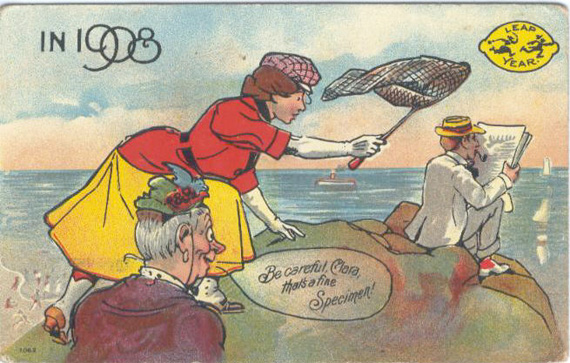
 
A husband-hunter spots her quarry in a 1908 postcard.
As a researcher interested in female cross-dressing, this sounds like a particularly juicy story to add to my compendium of examples. As a feminist, though, I have to wonder about the “tradition” of men proposing to women throughout history, which inevitably lead to designating one day every four years in which women could propose to men. (Too much more often than that, and things could get out of hand…)

It is well-known and documented that in the Middle Ages and Elizabethan era, sex before marriage was common and accepted. (For more on the history of sexuality in Europe and premarital sexual practices, check out books by Tim Hitchcock & Karen Harvey.) It seems hard to believe that in all cases, women waited for men to broach the subject. Undoubtedly, there were cases in which couples came together to the decision to marry, and in many cases, the man did not do the proposing at all--proposals were completely handled by the parents. On both sides.
 
She's no catch...but she's caught her man.
Marital traditions that we document the most clearly are often the traditions of the upper-classes and aristocracy, and many traditions that we think of as being around forever are actually quite new. Diamond engagement rings did not become mainstream until a DeBeers ad campaign in the early twentieth century, and white wedding dresses did not become popular until Queen Victoria’s wedding. Nowadays we would never consider wearing our wedding dress after the wedding day, but in The Age of Innocence by Edith Wharton (1920), we read that May wears her wedding dress out to various social events during the first year of her marriage.
 
Poor guy....tricked into marriage on Leap Day...

So, until I see some hard evidence about leap year marriage proposals in the form of pre-twentieth-century documents, I’m just a tad skeptical. It’s been an interesting tradition to read about, but for now, I think it might be more urban legend than actual tradition. When we take into account the many cartoons depicting ugly, creepy old women preying on unsuspecting young men, it’s hard not to think of this “tradition” as yet another way to discourage women historically from taking power into their own hands.

Saturday, February 13, 2016

Valentine’s Day Special: Restoration & Augustan Impotence Poetry

Many of us, when we are young and impressionable, are taught that poetry is language made beautiful, or, conversely, beauty rendered into words. In the English-speaking world, one of the earliest rhymes we learn is that saccharine Valentine chant:
Roses are red
Violets are blue
Sugar is sweet
And so are you!
For this reason, among many others, I enjoy breaking the poetic stereotype forcefully and with vigor (pardon the pun) by introducing my students to Restoration and Augustan Age impotence poetry. Impotence poetry of this time period, written in the heroic couplet form that dominated the poetry of the time, fuses together what we often think of as “poetic” language with the very “poetic” topics of love and passion and the rather “unpoetic” topic of impotence.
Pastoral scenes were popular in artworks
of the time period as well, 
such as this one, Arcadia by Frans Francken II.
Aphra Behn’s “The Disappointment” draws on the language and imagery of the pastoral (a common move in impotence poetry, alluding to its Ovidian origins), presenting us with the shepherd Lisander and his lover Cloris who meet in “a Thicket, made for love.” After overcoming Cloris’s fears of losing her virginity and therefore her honor and virtue, the lovers “extend themselves upon the moss” in preparation for the final “sacrifice” on the altar of love. However, we soon learn that poor Lisander, after seeing Cloris’s lovely bosom “rising” and “bare” is now “o’er ravished” and “unable to perform the sacrifice.” In the end, Cloris runs off, her virtue still intact while Lisander remains behind, blaming the innocent Cloris and her charms, “whose soft bewitching influence/ had damned him to the Hell of Impotence.”
By contrast, John Wilmot, Earl of Rochester, who wrote many sexually-explicit poems about his penchant for “swiving,” has only himself to blame in “The Imperfect Enjoyment.” Written in the first person, a little more crass and vulgar than Behn’s refined, poetic language, “The Imperfect Enjoyment” details the bedroom amours of the narrator and his Corinna (another pastoral name). Still, despite being a little more explicit about the sexual act, the language of Rochester’s poem delights with its romance-novel euphemisms: “My fluttering soul, sprung with the painted kiss,/ hangs hovering o’er her balmy brinks of bliss.”
Yet, when the unfortunate lover comes too soon, he finds himself unable to perform a second time. Soon the narrator is “the most forlorn, lost man alive….I sigh, Alas! and kiss but cannot swive.” Rather than blame his lovely partner, Rochester blames himself, or, rather, his “prick”: “Thou treacherous, base deserter of my flame/ False to my passion, fatal to my fame.” In the end, Rochester damns his own penis to “chancres” and “stranguary” while “a thousand abler pricks agree/ to do the wronged Corinna right for thee.” In Rochester’s poem, it is love, not lust, that renders him impotent: his penis being “so true to lewdness, so untrue to love.”
As a pair, these two poems illustrate two different approaches to the impotence poem: Rochester’s serves as a comic indictment of the libertine lifestyle while Behn’s, as beautifully-written as it is, illustrates the unjust fate of women who, like Cloris, can be both prey to sexual assault as well as damnable prudes who “bewitch” men into losing their virility and manhood. Lady Mary Wortley Montagu’s poetic response to Jonathan Swift’s “The Lady’s Dressing Room” illustrates another approach to the impotence poem: the impotence poem as poetic revenge. In Swift’s poem, he portrays in disgusting detail the inside of Celia’s dressing room. With meticulous attention to the abject and the disgusting, Swift’s Strephon “took a strict survey/ of all the litter as it lay.” Included in the survey are “various combs for various uses/ filled up with…/…A paste of composition rare/ Sweat, dandruff, powder, lead, and hair” as well as “puppy water”, a basin full of “the scrapings of her teeth and gums”, towels “begummed, bemmattered, and beslimed/ with dirt and sweat and earwax grimed”—not to mention her chamber pot! Montagu read Swift’s poem and apparently thought it a perfect illustration of a small-minded and vain little man (of course, she hated Swift for his politics too).

A lady at her toilette.
As a response to the poem, Montagu published her poem, “The Reasons that Induced Dr. Swift to Write a Poem Called the Lady’s Dressing Room.” In her version, Strephon is obviously Swift, and Celia is no better and no worse than a prostitute whom Swift tries to gain admittance to with “gallantry and wit” but who, in the end, must pay his four pounds for Betty’s charms. (In Montagu’s version, the poetic Celia is an everyday Betty.) Once inside Betty’s room, “the reverend lover with surprise/ peeps in her bubbies and her eyes/ and kisses both and tries—and tries.” Montagu’s Swift/Strephon is nothing but a “Fumbler”, as Betty calls him, whose “sixty odd” years have taken a toll on his sexual abilities. She refuses to return his money, even after he exclaims that the fault is not in him, but rather in the state of her chamber: “Your damned close stool so near my nose/ Your dirty smock and stinking toes” would make even a Hercules lose his mojo, he claims. Montagu further jests at Swift’s expense, writing that the “disappointed dean” of the poem proclaims he will write a poem that describes Betty’s mess in such detail, “the very Irish shall not come.” Betty’s delightful reply, which finishes out the poem, is “I’m glad you’ll write/ You’ll furnish paper when I shite.”

Restoration and eighteenth-century writers were fascinated with exploring sexual politics in their poetry, and the growing number of female writers at this time meant that women could bring their own views on sex and desire into the conversation. While poetry that concerns itself with love, relationships, longing, and lost love often dominates what we think of as poetry, the sub-genre of impotence poetry can be, in some ways, more revealing about social attitudes towards the body, failure, and the human condition even as it changes our idea of what poetry can be and what it should be. Lastly, for those of us working on the history of sexuality, impotence poetry puts the body and notions of embodiment front and center in ways that are fascinating and humorous.


Tuesday, February 2, 2016

Aphra Behn on Justice

Aphra Behn
This semester I’m teaching an upper-level English course on Restoration and eighteenth-century literature. We started with two works by Aphra Behn: the play The Widow Ranter (1689) and the short fiction The Fair Jilt (1688). The first tells the story of a disparate band of Englishmen and women in the Jamestown colony in Virginia at the time of Bacon’s Rebellion, a historical event that Behn modifies for the purposes of drama. The second is a work of “amatory fiction” that recounts the scandalous amours of an evil, plotting young woman named Miranda, who, when she can’t get what she wants, resorts to extremes (lies, deception, murder—the usual). In both works, however, as in many of her others (the play The Rover, for example, or her novella Oroonoko), the notion of justice and its inverse, injustice, play a prominent role.
           In The Widow Ranter, justice has been suspended for the colonists, as in the wake of a power vacuum, the colonial council makes all the decisions. The council is made up of a motley crew of immigrants to the new world, many of whom have extremely dubious credentials. As Friendly tells his newly-arrived pal Hazard, “for want of a governor we are ruled by a council, some of which have been perhaps transported criminals, who having acquired great estates are now become Your Honour, and Right Worshipful, and possess all places of authority” (Act I, Scene I). The members of the council are indeed scoundrels, as represented by Behn in the play. With names like Timorous, Whimsey, Whiff, and Boozer, it is evident that the council members are not to be trusted. In fact, they are all great cowards, and their cowardice becomes part of the comic relief, even as it suggests one of the play’s most overt critiques of power and governance.
Real life Nathaniel Bacon.
            In Act III, Scene I, we enter the courtroom, and Hazard is accused of drawing without provocation against two members of the council. The entire courtroom scene is a farce of justice, as the play portrays the justices indulging in punch in the courtroom and presiding at the hearing while drunk. Further, when all is revealed, we learn that Hazard was defending himself against Dullman and Boozer who struck him first. The questions of what is allowable “under the law” surfaces in this scene, where it is comic, but inflected with serious consequences. The problem of what is legal and what is just is painted in broader strokes in the case of Bacon and his rebellion. The inhabitants of the colony bemoan that what Bacon, the brave and valiant Bacon, did by inciting his own war against the Indians without leave from the council, was perhaps just, but it was not legal.
            In The Fair Jilt, the miscarriages of justice are, if possible, even more complex. Miranda manipulates the justice system in order to get the object of her affection convicted of rape. Father Francisco refuses her overtures of love, and she, obsessive young maiden that she is, contrives to make it look as though he has raped her. He is convicted and put indefinitely into prison. While he molders in jail, Miranda meets Prince Tarquin, seduces him, marries him, and begins spending extravagantly. She spends her own dowry as well as that of her unmarried, much younger sister Alcidiana. When Alcidiana prepares to marry and demands her dowry, Miranda seduces a young page, Van Brune, and convinces him to kill Alcidiana for her. The attempt ends with Van Brune’s confession, his conviction and death, and Miranda’s disgrace. Miranda doesn’t learn, however, and resorts to even greater extremes: she convinces her husband, Tarquin, to commit the murder of her poisoned-but-not-killed sister. He shoots and misses; he is caught; he and Miranda are both imprisoned. Miranda is banished, and Tarquin is sentenced to death by beheading; the beheading is botched, however, and he is saved by the crowds, recovers, and reunites with his banished wife. At the end, we learn that the two of them live a long and happy life and that Miranda is repentant.
            My students were rather unsatisfied, to say the least, with Miranda’s happy ending. They wanted her to receive a proper punishment for the way she had lied, manipulated, deceived, and caused the imprisonment and/or death of innocent people. Is the ending of The Fair Jilt an injustice to all those Miranda harmed with her obsessive selfishness? Does it illustrate the dangers of not educating women and allowing them to become obsessed with their own youth and beauty and their powers of seduction? Or is this a searing indictment of male blindness? In Behn’s works, nothing is simple or easy, even if we are momentarily tempted to consider The Fair Jilt nothing more than a silly telenovela.

            Behn lived in a tumultuous time, and her own life story, what we know of it, seems to suggest that she witnessed many injustices. Her works are full of melodrama and comedy, yet their complex relationship to issues of justice, the law, money, power, and relationships force us to re-examine the darker side of these stories. The law, she reminds us, is made by men, and men are fallible, petty, blind, jealous, selfish, and power-hungry. They project these same negative qualities onto women—yet they embody these qualities themselves and with much more far-reaching and dangerous results.

Friday, November 20, 2015

The Secret Diaries of a Regency Lesbian

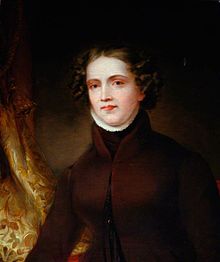
Anne Lister,
Regency Lesbian
I finally managed to watch The Secret Diaries of Miss Anne Lister, a BBC production from 2010 that tells the story of Anne Lister, an upper-class Englishwoman who defied the conventions of her time to live and love as she wanted to.

Lister, for those of you unfamiliar with her story, lived in Halifax, in Northern England, from 1791-1840. And although her life overlaps quite a bit with that of Jane Austen, her life story and her diary reveal quite a different world than the one Austen recreates in her novels. Lister kept a secret diary, much of which was written in code, and the coded bits are, naturally, the juicy bits. In her copious diary, Lister details her love affairs with various women, as well as her interest in women and her disinterest in men.

Her diaries number 4 million words and naturally touch on many other subjects, but for historians of sexuality, her diary is most important for the way that Lister writes about her same-sex desires and her sexual identity. The “no homosexuals before 1900 rule” that many post-Foucaultian scholars considered to be (used to consider?) a hard and fast assumption seems ridiculous when we consider Lister. She clearly thought of herself as “a woman whose primary romantic and sexual attraction is to other women.”

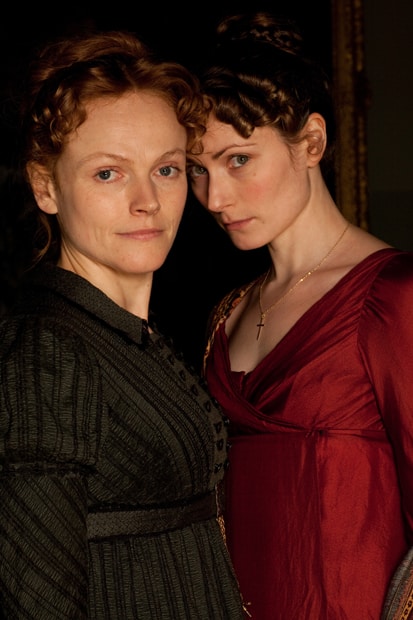
Maxine Peake, left, as Lister, &
Anna Madeley as Mariana Belcombe.
The BBC production, however, was a disappointment. While Maxine Peake, who played Lister, seemed up to the part, she was miscast. She looks absolutely nothing like the portraits of Lister, with her bouncing red curls instead of Lister’s dark brown locks, and the script and story focused on portraying Lister as romantic, desperate, and hysterical. The time line of her life was truncated and mangled in the film, and there was no discernible story arc.

The basic narrative focuses on Lister’s problematic affair with real-life lover Marianna Belcombe (later Lawton) and Lister’s later successful relationship with wealthy heiress Ann Walker. The film also represents some of the other aspects of Lister’s life: her scholarly interests, the changes she made to her home, Shibden Hall, and her interests in engineering and coal-mining. The film also represents some of the negative reactions Lister faced to her increasingly masculine appearance and clothing and the suspicion surrounding her and her female “friends.” Some people in the area who knew of her odd ways called her “Gentleman Jack”—and not in a nice way.

Lister’s life could indeed make a wonderful, exciting, and thought-provoking film, but this one just wasn’t it. Far more interesting was the mini-documentary included in the special features on our disc, called “The Real Anne Lister” with Sue Perkins. The documentary includes interviews with various scholars who study Lister and Regency England, including Helena Whitbread who is the main editor of Lister’s diaries.

“The Real Anne Lister” takes us into Shibden Hall as it looks today and to the boarding school where Anne was sent as a teen—and where she had her first love affair with another girl. In between interviews with scholars and historians, Sue Perkins walks us through Lister’s life and loves, giving us a far more complete picture of Lister as a woman interested in intellectual pursuits, one who actively pursued other women at a time when such relationships were stigmatized, and one who had many other interests as well, including mountaineering, something the fictionalized film does not include.
 
Shibden Hall in Halifax, England.
Perkins presents Lister as a problematic figure, one who, as contemporary lesbians, we can admire for her boldness and her decision not to live in the closet, but who is also deeply troubling and perhaps even unlikable. Perkins notes in the documentary that Lister seems heartless at times, forgetting her lover from her school years, Eliza Raine (who died young after being sent to an insane asylum), and seducing other women thoughtlessly, selfishly. Perkins also faults Lister for being class conscious in her pursuit of other women, focusing mostly on women of the upper middle class and upper class—women like Lister herself.

A later portrait of Lister reveals the "mannish"
quality that eventually caused her lover, Mariana,
to leave her.
But we don’t have to like Lister in order to find her fascinating or a worthwhile person to study, especially when it comes to the history of sexuality. After all, no one is sitting around asking if they like Sappho or Don Juan as a person. Perhaps we should be asking, instead, what role does “likeability” and “relatability” have to play when we study real life persons in the past? Undoubtedly most writers of biographies come up against a fact or incident in the life of their subject that turn them off, or maybe even creates a permanent sense of dislike for this person that they are writing about.

Perhaps that was the reason I didn’t like The Secret Diaries of Miss Anne Lister. Aside from the pacing being a bit slow, I felt like I just didn’t like Anne Lister. And I wanted to. But her fictionalized character didn’t seem bold and brash, or even cold and cunning; she seemed desperate and a teensy bit annoying. I do hope that her story gets take up again, though, and remade into a better film (or mini-series, or even a musical!) because it’s a story worth knowing.


For every brash, bold, rich Anne Lister, there are dozens of other, quieter, lesser-known, or simply poorer women in history who loved other women and who defied conventions—perhaps in a less splashy way. Their lives are just as worth knowing and understanding as those of queens and duchesses, and their presence in the past suggests a more sexually diverse Regency world than most Austen adaptations present us with. 
On a positive note, the BBC production doesn't shy away from
representations of female same-sex desire and sex acts.

Friday, October 23, 2015

Dangerous Desires & Gothic Pastiche: Crimson Peak

The official film poster for
Crimson Peak (2015).
There is something alluring about the Gothic. The Gothic is a malleable, fluid category of the scary story, one focused rather broadly on the aesthetics of isolation and gloom, the fascination with the things that terrify and attract us, and on the hold that the past has on the present. It is about the monstrous thing that is right before us, about taboo desires, and about that heady mixture of pleasure and fear bubbling just beneath the surface of everyday life.

For many of us who study the eighteenth- and nineteenth-century novel, the Gothic genre, adaptations, and/or literary gender studies, a film like Crimson Peak marks an exciting addition to the category of the Gothic, in part because director Guillermo del Toro has been very candid about his literary influences and these influences are palpable in the film.

Among others, del Toro has mentioned the novels of Ann Radcliffe and Matthew Lewis, Wuthering Heights, Jane Eyre, and Great Expectations. There are also links in the film to the story of Bluebeard, Edgar Allan Poe’s story “The Fall of the House of Usher,” and to Rebecca—and undoubtedly many others.

In an interview, del Toro said that he has taken many of the ideas of the earlier Gothics but added contemporary gender politics into the mix. While the horror genre, writ large, has offered in recent years more opportunities for strong female protagonists to fight actively against the evil that threatens them, much of the classic Gothic genre features female protagonists who must be saved by others.

Illustration from The
Mysteries of Udolpho.
Classic Gothic texts like The Castle of Otranto, The Mysteries of Udolpho, Frankenstein, and Dracula feature women who are threatened, locked up, and either killed or saved by male characters. Although Charlotte Brontë’s Jane is ultimately able to run away from the bigamous Rochester and finally accept him on her own terms, her financial independence that allows for the final reunion comes from an inheritance from her uncle. Even Emily Brontë’s virulent, violent Cathy can only control Heathcliff once she is a ghost.

By contrast, the protagonist and central antagonist of Crimson Peak are both women—the independent-minded, aspiring writer Edith Cushing (Mia Wasikowska) and the gifted pianist but very creepy sister-in-law Lucille Sharpe (Jessica Chastain), respectively. Tom Hiddleston’s character of Sir Thomas Sharpe resists recreating the traditional Gothic villain, as he is equal parts romantic suitor, child-like inventor, and partner-in-crime to Lucille, whom the film ultimately paints as the instigator of evil at Allerdale Hall.

The character of Edith obviously draws on past Gothic heroines through her initial innocence, symbolically represented by her bright yellow flowing hair and her elaborate fin de siècle dresses and coats, as well as through her romanticization of Sir Thomas, a man her father does not wish her to marry. (The 1901 American setting and Edith’s imposing businessman father remind one vividly of Henry James’s “Washington Square.” This is unsurprising as del Toro has mentioned James as a major influence and has said that Edith’s name is an homage to another fin de siècle writer, Edith Wharton.)
 
Like many a Gothic heroine, Edith is innocence embodied;
it's her curiosity that will get her into trouble--or possibly save her?
Still, Edith manages to come into her own, even as she yields to other Gothic conventions: she allows herself to be swept away to an isolated, decaying old English manor hour; she cannot overcome the curiosity to explore the house that has been forbidden to her; and she refuses to see the dreadful secret of Sir Thomas and his sister until it is too late.

On the other hand, Edith is sexually assertive in her relationship with her husband, and the film keeps its female bodies clothed, resisting the spectacle of female nudity (though not necessarily that of male nudity!). In the second half of the film, once Edith must acknowledge the danger of her situation and the various threats to herself and her survival at Allerdale Hall, she fights back. The mixture of Gothic conventions with those of contemporary slasher flicks in the last twenty minutes of the film allow for Edith and Lucille to meet on the battlefield with no men to interfere (at least, not physically).

Thematically, of course, the film is borrowing from and embroidering various Gothic themes that exist even in texts where the female characters don’t have much power: the monstrous feminine, transgressive female desires, the fear of female sexuality, familial violence and revenge, etc. Crimson Peak is pastiche homage to the Gothic, giving us the spectacle of female power that is not wholly unique, but irresistible nonetheless.

In part, the gender politics of the Gothic, which are often both conventional and transgressive, traditional and queer at the same time, are part of the genre’s allure.

Eva Green's "Vanessa Ives" is another
Gothic heroine remade from the Gothic
novels the show draws on.
The literary elements of the film, as well as the film’s homage to various Hitchcock films, old B horror dramas, as well as classic Gothic films of the twentieth century (such as The Haunting of Hill House) make Crimson Peak, like other Gothic imitators (The Woman in Black and Penny Dreadful come to mind) alluringly familiar as they walk the fine line between high drama and camp, sexy and sexually perverse.

Why do we return so often to the Gothic? In part, it must be because the Gothic embodies so clearly the idea of the sublime, which crystallized in the Western imagination around the same time as the Gothic itself. The idea that we can experience terror and that we can explore certain taboo subjects within the “safe” confines of literature (and now also film and television) is alluring, exciting, and seductive.

The Gothic is also better dressed than many of its horror relatives; it is as much about the spectacle of interiors as it is about interiority, as much about velvet and lace as it is about spiders and ghosts. It holds out to us the possibility of elegance now lost, fashions of the dusty past, and those elaborate arabesques of Charlotte Perkins Gilman’s eponymous yellow wallpaper.


Finally, the Gothic is a genre (if I can go so far as to call it one) in which gender and sexuality are at the front of center of the story. Gender roles, sexual desires, and the body are elements of every Gothic story, and even the most seemingly conservative of such stories, like The Castle of Otranto or The Mysteries of Udolpho, for example, hold out the possibility of transgressive femininity, an idea that excites and terrifies even now in 2015.

Wednesday, October 14, 2015

Two Feminisms: Mary Astell and Hortense Mancini


Hortense Mancini,
Duchess of Mazarin
It happens more often than I’d like to admit: despite writing an entire dissertation on cross-dressing women in British literature and culture of the long eighteenth century, I find I’ve overlooked a prominent female cross-dresser. Today’s case is that of Hortense Mancini, Duchess of Mazarin, and one of Charles II’s many mistresses.

Mancini’s flamboyant, exciting, and at times perilous life has been documented and described not only in books, like her biography The Mazarin Legacy, by Toivo David Rosvall and in Elizabeth C. Goldsmith’s The King’s Mistresses, but also in various wonderful blog posts on the blogs Two Nerdy History GirlsThe Monstrous Regiment of WomenWonders and Marvels, as well as MadameGuillotine.

 I, however, learned about Mancini just today as I was considering including Mary Astell, the “first British feminist”, in the Month of Dangerous Women on my own blog. Astell’s Some Reflections UponMarriage was written in direct response to the case of the Duchess of Mazarin and her husband’s suing for divorce after many years of separation.

Protofeminist Mary Astell
Astell’s opinion of the case is tinged with condemnation of Mancini’s behavior; Astell was, after all, a rather conservative feminist. She writes that “Had Madam Mazarine's Education made a right improvement of her Wit and Sense, we should not have found her seeking Relief by such imprudent, not to say Scandalous Methods, as the running away in Disguise with a spruce Cavalier, and rambling to so many Courts and Places, nor diverting her self with such Childish, Ridiculous, or Ill-natur'd Amusements, as the greatest part of the Adventures in her Memoirs are made up of.”

Oh yes, did I mention? Mancini published her memoirs…I can’t wait to get my hands on those!

In any case, however, to return to Astell, I was intrigued, naturally, by her claims. Some quick research into the life of Mancini revealed not only that she frequently cross-dressed as a man, but also that she openly had lovers of both sexes and, at one point, engaged in a duel with swords with Anne Lennard, Countess of Sussex, the illegitimate fifteen-year-old daughter of Charles II by another of his mistresses, Barbara Villiers. Lennard was most likely also one of Mancini’s female lovers at court. 

Whatever Astell thought of Mancini and her “ill-natured amusements,” Hortense Mancini reminds us that there were women in the past who lived life fully, dangerously, and dashingly, with little regard to what the rest of the world thought of them. This is not to say that Astell was wrong about everything either. Astell’s thoughts on marriage and divorce reveal a woman far  beyond her time, one who believed that

“To be yoak'd for Life to a disagreeable Person and Temper; to have Folly and Ignorance tyrannize over Wit and Sense; to be contradicted in every thing one does or says, and bore down not by Reason but Authority; to be denied ones most innocent desires for no other cause, but the Will and Pleasure of an absolute Lord and Master, whose follies a Woman with all her Prudence cannot hide, and whose Commands she cannot but despise at the same time she obeys them, is a misery none can have a just Idea of, but those who have felt it.”

Clearly Astell believed that men and women should have simpler, more direct recourse to divorce in cases where the relationship is of no benefit to one or both of sides of it. In the Reflections, as well as in her Serious Proposal to the Ladies, Astell eviscerates many of the common marital practices of her time period while advocating for greater educational opportunities for women.

For these reasons, this week’s contribution to the Dangerous Women series is a double-whammy. Hortense Mancini and Mary Astell were both “dangerous women” by my definition—they dared to step beyond the “traditional” role of women, to assert themselves as independent, free-thinking individuals, and to challenge society’s expectations for their sex.

The lives of these women and their writings also made me think about the different feminisms and forms of female empowerment that women espouse today. Feminism is still stigmatized in our society—as are women of strength, independence, power, and intelligence.
 
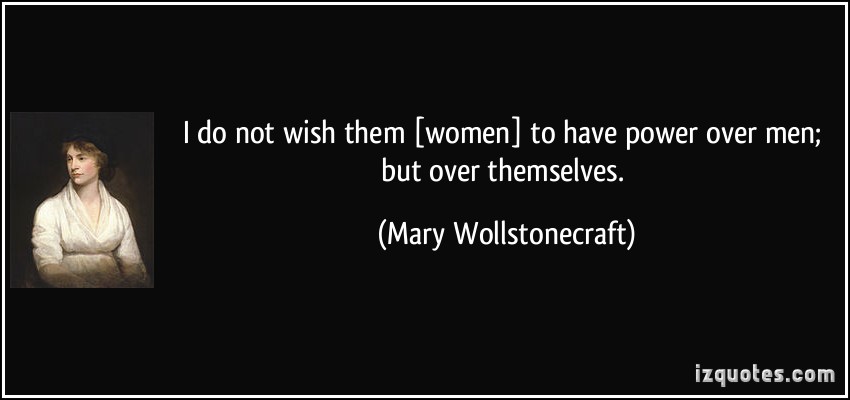
Another early feminist, Mary Wollstonecraft, believed like Astell that women needed
education in order to empower themselves and their countries.
This quotation of hers, however, is ambiguous enough to encompass a variety
of different ways in which women today might gain "power over themselves."
Mancini epitomizes women who live as they wish, who use their relationships with men to facilitate and support their lives and interests, who live freely but perhaps without knowledge of or interest in academic debates on feminism. Conversely, Astell epitomizes women who believe that if women want equality and respect, they must be educated, intelligent, and aware of how their behavior may at times contribute to their oppression.

These are only two attitudes, of course, towards female empowerment and feminism, and many men and women’s ideas may fall somewhere in between. Further, many of us draw on both of these women’s attitudes during our everyday lives. I don’t think these ideas and attitudes have to be opposed to each other, either. Contemporary feminism emphasizes choice, and I choose to admire both Mancini and Astell for their determination, intelligence, independence and panache, however they ultimately chose to express themselves.

Thursday, October 1, 2015

18th-Century Female Pirates

Black Sails on the Horizon: Female Pirates Anne Bonny and Mary Read

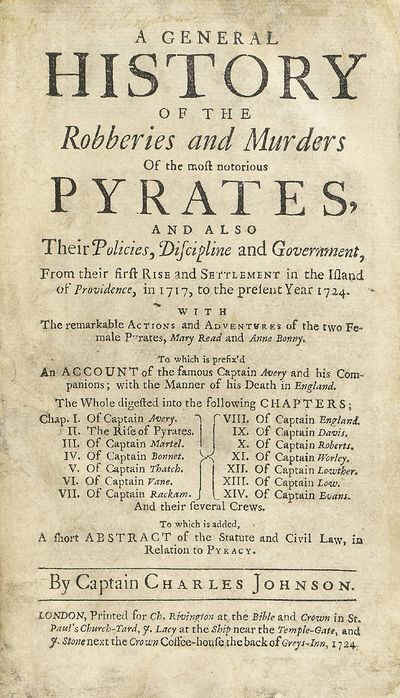
From “The Life of Anne Bonny”, A General History of the Pyrates (1724)
“…she became acquainted with Rackam the Pyrate, who making Courtship to her, soon found Means of withdrawing her Affections from her Husband, so that she consented to elope from him, and go to Sea with Rackam in Men’s Cloaths…”

“The day that Rackam was executed, by special Favour, he was admitted to see her; but all the Comfort she gave him, was, that she was sorry to see him there, but if he had fought like a Man, he need not have been hang’d like a Dog.”

The stories of Anne Bonny and Mary Read are fascinating and confusing, surprising and entertaining. They were printed in A General History of the Pyrates, now attributed to Daniel Defoe, which recounts numerous tales of piracy from the late seventeenth- and early eighteenth-centuries, including the tale of the infamous Captain Teach, aka Blackbeard. The volume, available through Dover Thrift, numbers over 700 pages, and includes masses of information not just about various pirates, but also their trials, lists of vessels, maps of the Caribbean, and illustrations of many of the pirates profiled in its pages.

Among the list of pirates appear the names of female pirates Anne Bonny and Mary Read, both of whom, according to their stories, were passed off as boys while still children, came from impoverished backgrounds, and entered into piracy for the love of men. They passed themselves off as men in order to maintain their gender a secret aboard ship and, according to the section on Mary Read, eventually the two women met aboard Captain Jack Rackham’s ship, leading to an interesting case of mistaken identity:

“Her [Mary Read’s] sex was not so much as suspected by any Person on board till Anne Bonny, who was not altogether so reserved in Point of Chastity, took a particular Liking to her; in short, Anne Bonny took her for a handsome young Fellow, and for some Reasons best known to herself, first discovered her Sex to Mary Read; Mary Read knowing what she would be at, and being very sensible of her own Incapacity that Way, was forced to come to a right Understanding with her, and so to the great Disappointment of Anne Bonny, she let her know she was a Woman also.”

The text goes on to mention how Rackham became jealous of Mary Read in her male persona, thinking that she/he was a threat to his relationship with Bonny. Bonny had to reveal that Read was also a woman so he wouldn’t “cut her new Lover’s Throat.”

The stories of the female pirates, as related in Defoe’s History, are less interested in recounting battles and fights than they are in detailing their cross-dressing as children (in the case of Anne Bonny) and various sexual liaisons the women had with men aboard ship (in the case of Mary Read). Nevertheless, as the quotations from Bonny’s history at the beginning of this post indicate, the women were thought to be remarkably vicious, strong-willed, and conniving, “pleading their bellies” once they were caught by the authorities to avoid hanging.
 
The illustration of Anne Bonny and Mary Read from the General History.
The Stars show Black Sails has mixed fact with fiction and created two characters out of these narratives for the show: Captain Jack Rackham (Toby Schmitz) and his cross-dressing consort Anne Bonny (Clara Paget). The costumers appear to have done their homework, as Bonny’s character appears in loose trousers and jacket, much like in the engraving of Anne Bonny and Mary Read included in the General History.
 
Paget and Schmitz as Bonny and Rackham on Black Sails.

From there, however, it seems that the television show has left the rest of their stories behind, and, as yet, the show does not have a Mary Read character. The character of Anne Bonny, though, seems just as vicious and violent as her literary predecessor and, as I gear up to watch season 2 (yes, I’m behind!), I hope her role will blossom even more.

The enduring appeal of these characters does not stop at their recreation on Black Sails, as I also discovered that Read, Bonny, and Rackham are also characters in the video game Assassin's Creed, which, judging from the Wiki description, also alludes to information from the General History

The stories of these women, whether wholly or partially fabricated, suggests new avenues of representations in the tired old pirate stories of men on ships, just as the story of Teresia Constantia Phillips suggests a new variation on the old theme of a woman caught in a bad marriage.